21 April 2026
Waiting for Vlad
Or, Tajikistan's capital Dushanbe is worth the effort
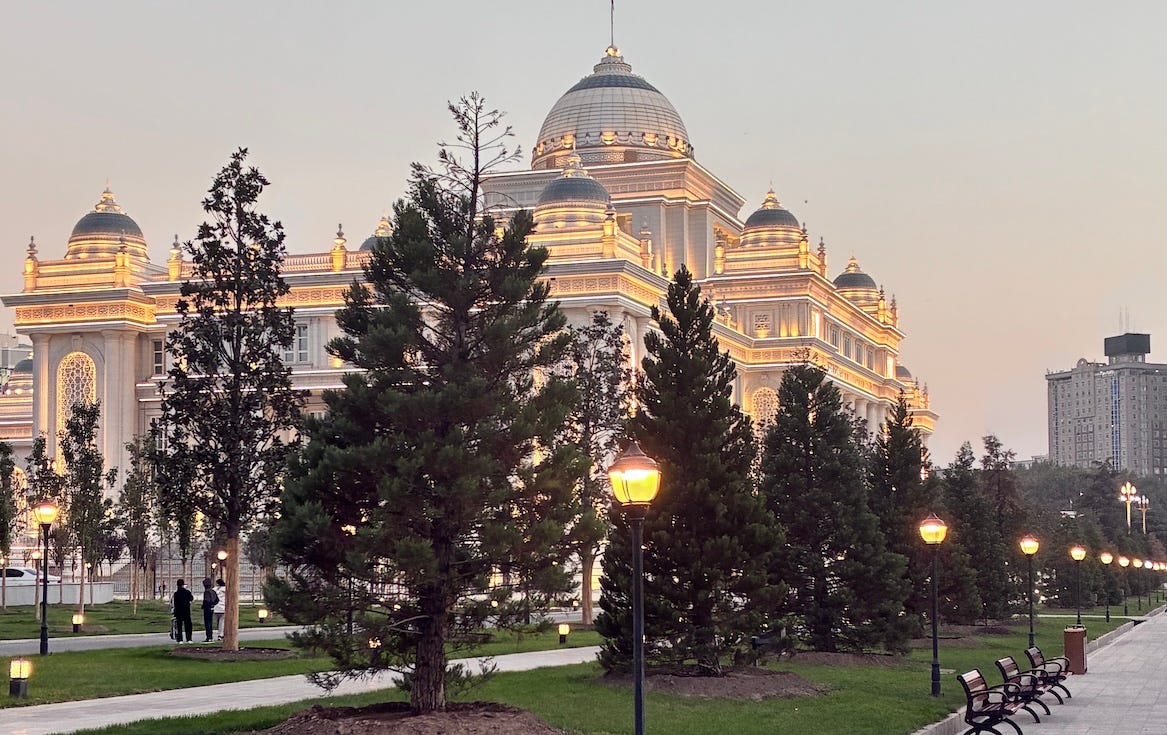
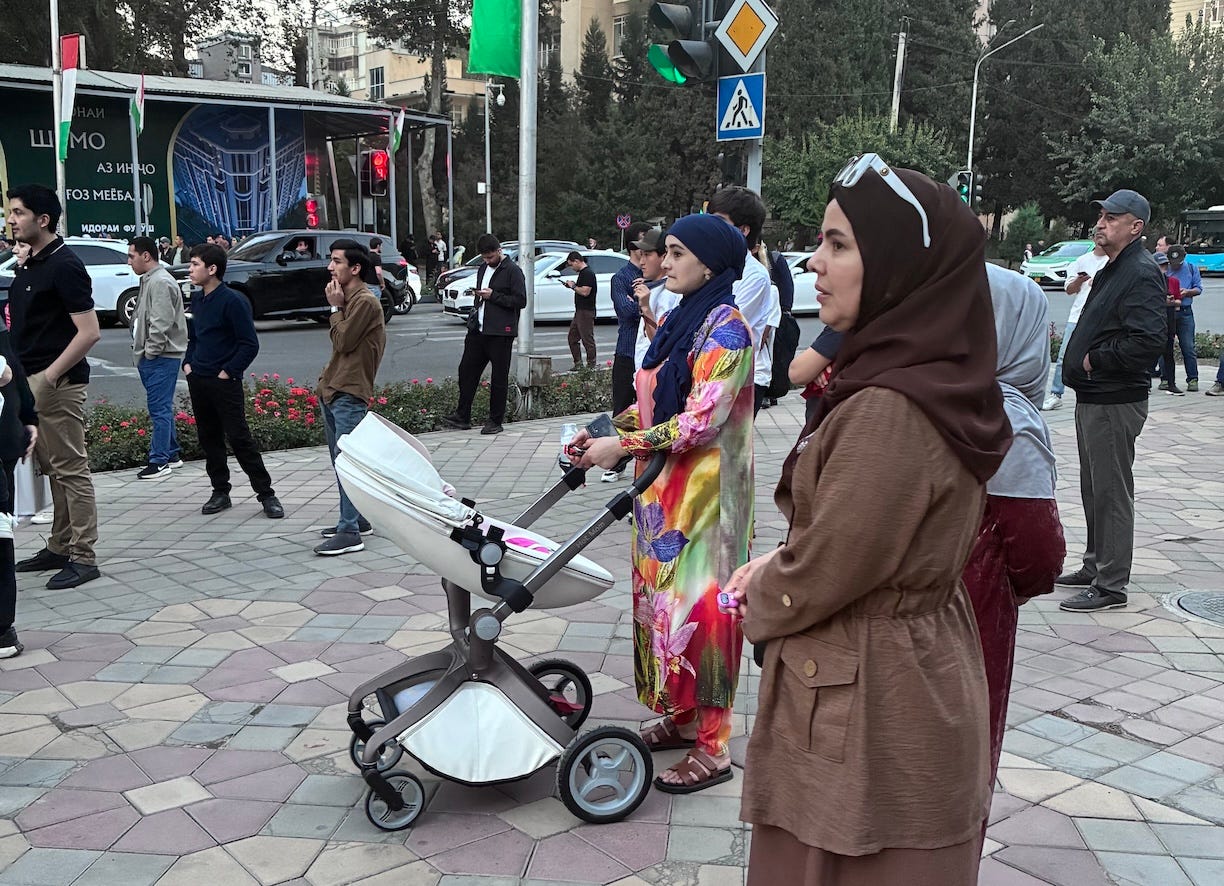
I’d been in Dushanbe for about forty-five minutes when the police shut the city centre down. Cars, pedestrians, everything. They told everyone to stay where we were with the firm politeness of people who’d clearly done this many times before. So there I stood, in the warm heat of an October evening, for the best part of an hour. Why? So that Vladimir Putin’s motorcade could reach the airport.
He’d been in town for a summit of the CIS (the Commonwealth of Independent States, a loose diplomatic alliance of some countries once occupied by Russia that limps along mostly because Moscow wants it to). I’d come for the Dushanbe Investment Forum, which took place a day or two later and had the considerable advantage of not being populated entirely by Russians.
So there I was. On my first walk through the city, wondering whether this was a bad omen. It turned out not to be.
Getting in to Tajikistan is a bit of a faff, at least with a UK passport. The country runs an e-visa system that works, up to a point. I paid the fee and uploaded my documents, but then entered a bureaucratic holding pattern during which precisely nothing happened for the best part of three weeks. In the end it took a travel agency (paid, of course) to prod the machine back into action. If you’re planning a trip and find yourself stuck in the same limbo, drop me a line and I’ll tell you whom to get in touch with.
The airport was the other thing I’d been warned about. There are plenty of lurid accounts online, not all of them ancient history, of immigration and customs officers at Dushanbe finding creative reasons to invent ‘fines’ on the spot. None of that happened to me, coming or going. In fairness, arriving as a forum guest meant I was met directly off the plane and walked through a VIP lane where the whole business was settled in about thirty seconds (passport stamped, driver waiting, done). Not, I will admit, entirely representative. But on the way out, without any of the red-carpet nonsense, I cleared security and passport control in under ten minutes and nobody asked me for a thing. The shakedown stories appear to be out of date. Which matters, because they’re the first thing people will tell you about arriving in Dushanbe, and by now they probably shouldn’t be.

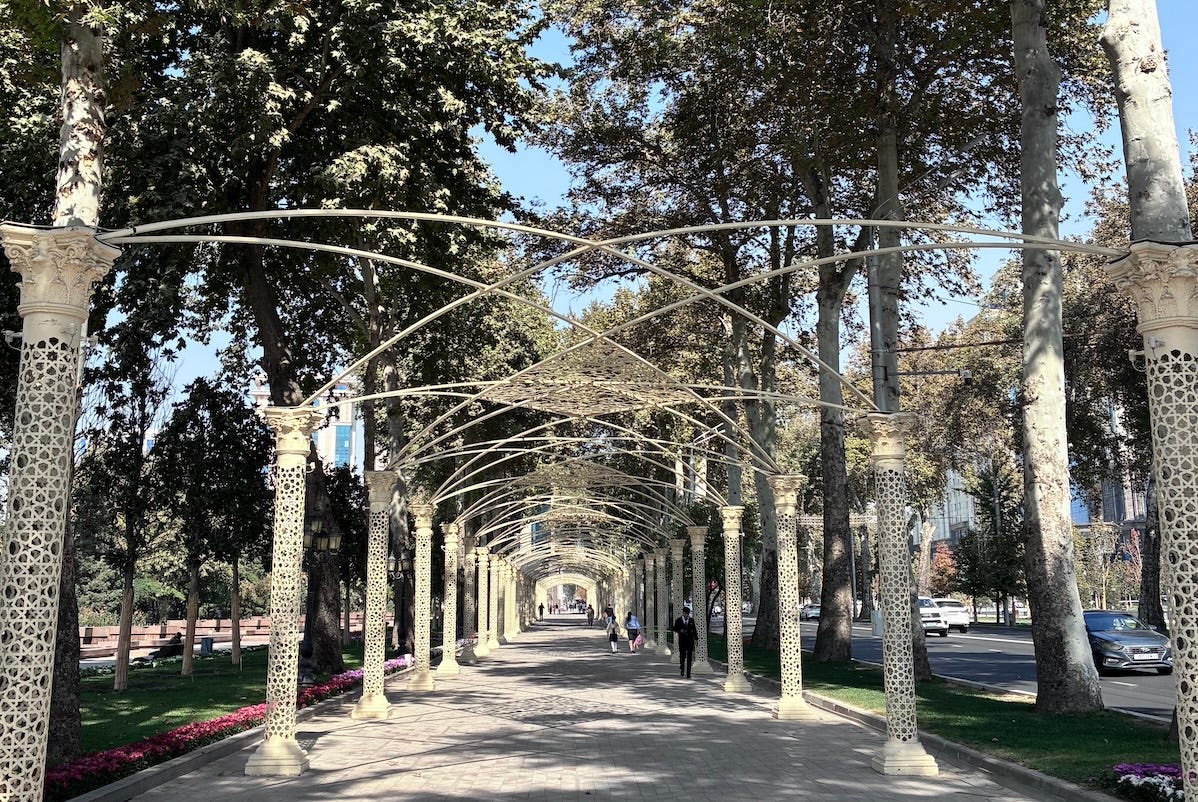
For all the faff at the front end, the city itself, to my surprise, is lovely. Dushanbe has been comprehensively rebuilt (or its centre has, at any rate) over the past twenty-odd years, and the result is a place that is sparklingly clean. Not clean in that sterile, OCD, Singapore way, but clean in the sense that someone sweeps the pavement at four in the morning and then again at regular intervals throughout the day. Pavements are broad, trees are everywhere. In late October, with temperatures still in the high twenties, I was grateful for the shade.
Several of the boulevards are absurdly wide, the work of a government keen on a particular kind of grandeur. But on foot it’s fine.
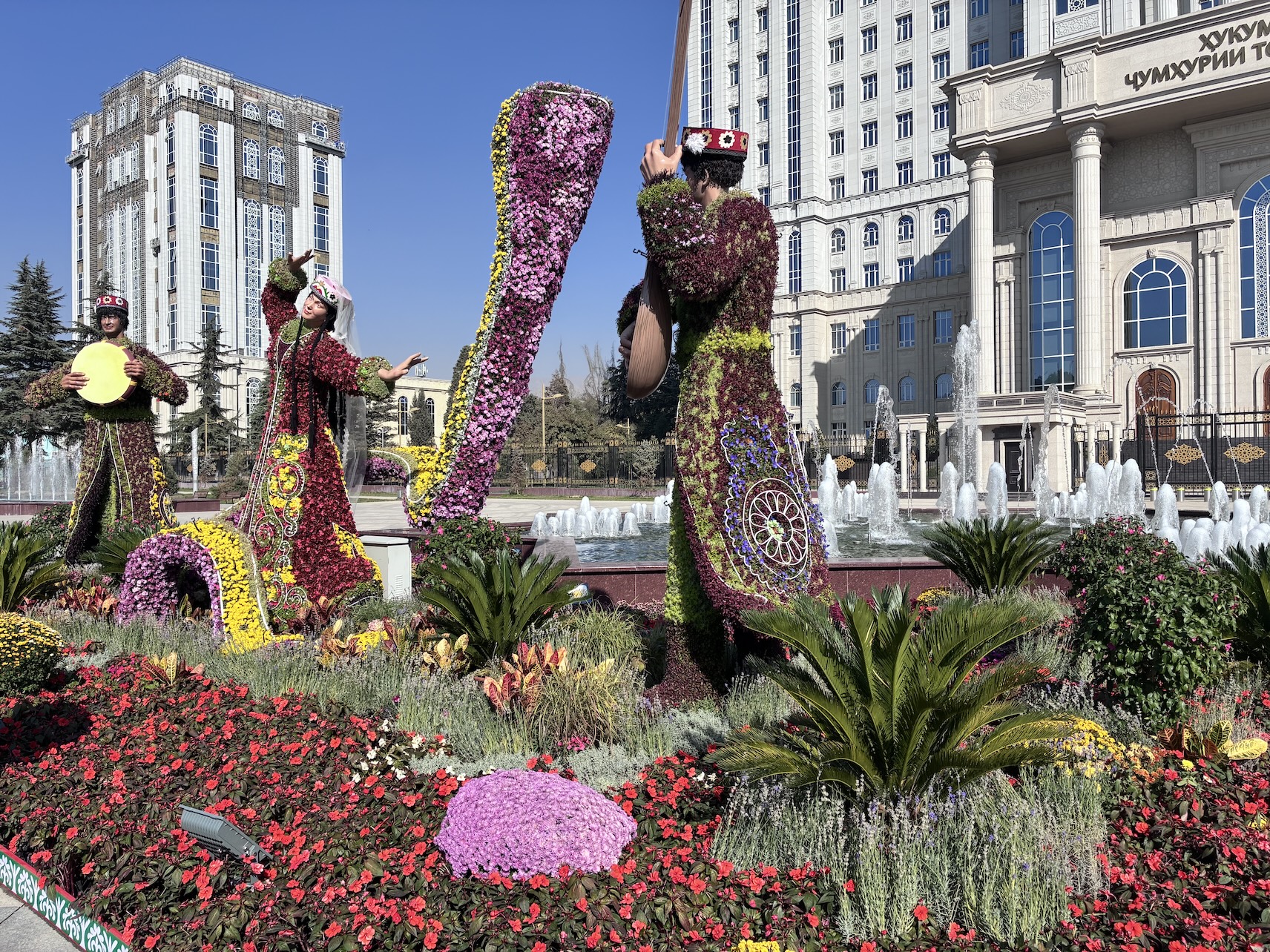
And then there are the flowers. Dushanbe loves a flower arrangement. Every roundabout, every public square, every public building forecourt, every reasonable patch of municipal ground features some sort of extravagant floral installation, each apparently in competition with the last for sheer size and ambition. At once both rather nice and rather bonkers.
Getting around, incidentally, was mostly on foot for this correspondent. There’s no ridesharing app worth the name (there may be one by now, but in October there wasn’t). Taxis are everywhere instead, hundreds of them, all brand new, all painted an identical mix of white and green, all circling the streets in a never-ending procession. You’d think this would make catching one straightforward, but you’d be wrong. They’re so cheap that locals use them as a sort of de facto bus service, and every single one I tried to flag already had a passenger or was heading somewhere specific. So I just walked everywhere. Which, happily, turned out to be the right thing to do.
–
Georgian food is the default export cuisine of the former USSR (find me a city once occupied by Russia that doesn’t have a dozen Georgian restaurants and I’ll buy you a khachapuri), and Shvili is a perfectly competent example of the genre. Not brilliant but perfectly pleasant. A bit pricier than the Dushanbe norm, but perfectly reasonable. They had draught beer, too. (Back in October I was still drinking alcohol. I’ve since given it up, for good). I’ve eaten better Georgian food in Tbilisi, but I’ve also eaten worse Georgian food in Tbilisi.
But far more memorable was Bonu, an Iranian restaurant on the top floor of a small, nondescript business centre, the sort of place you could walk past twenty times without noticing. I would not have found it on my own. I found it because Nigora Fazliddin of the UNDP took me there, and for that piece of generosity I remain very grateful indeed.
Many of the staff at Bonu, whose owner is Iranian, are Afghan refugees. Tajikistan shares a long border with Afghanistan and a deep linguistic and cultural overlap with it (Tajik is essentially a dialect of Persian; Dari, the main language across the border, is another), and the country has absorbed tens of thousands of Afghans since 2021, on top of many who were already there. Legal protections are patchy. The economics are hard. And yet in this small, bright, slightly hidden restaurant, the team produced one of the best meals I ate anywhere last year.
The lamb shank in particular was extraordinary. Slow-cooked, rich, collapsing at the merest prod of my fork, served with saffron rice done the proper Persian way with the crust (tahdig) at the bottom. If you’re ever in Dushanbe, it’s worth the hunt.
–
Some numbers, because they help for context. Tajikistan is the poorest country in Central Asia, by a comfortable margin, with GDP per capita of around $1,300. Something like half of its national income comes from remittances, nearly all of them sent home by Tajik migrant workers in Russia, which makes it one of the most remittance-dependent economies on Earth. This is the single most important economic fact about Tajikistan, and you can’t really understand the place, or the rather elaborate politeness extended to Vladimir Putin during his visit, without it.
That said, the government has been more assertive towards Moscow in recent years. President Emomali Rahmon (in office since 1994, which makes him one of the longest-serving heads of state anywhere in the world) has on occasion publicly told Putin that Central Asia expects to be respected as an equal rather than a post-Soviet afterthought. China, meanwhile, has been steadily moving in through infrastructure loans, Belt and Road projects, a new highway, growing trade volumes.
–
More than one local mentioned to me, at different points and with different emphases, that Dushanbe is not Tajikistan. It’s a lot wealthier, a lot more polished, and a lot more invested in. You can see the evidence in the streets, the flowers. Step outside Dushanbe, into the Pamir highlands or the fringes of the Fergana Valley, and the picture is very different. Rural poverty remains substantial, and infrastructure is thin. What I saw was the most polished version of the country on offer.
-
But the Dushanbe I got was lovely. Quirky and surreal in places it is a city that occasionally felt like a slightly stagey film set still under construction, flowers in place before the cast had arrived. The food was great and the walking was a pleasure. Even the Putin delay was, in hindsight, really just a story to tell.
I enjoyed the place enormously and I’d have stayed longer if I could. And I want to go back, properly, to see the rest of the country, ideally at a time when Putin is somewhere else.
-
Notes
From Europe, Dushanbe is not easy to get to. I flew in via Bishkek (Kyrgyzstan) and left via Baku (Azerbaijan). The best connections with Europe are offered by Turkish Airlines, although at some cost. Tajikistan’s own Somon Air offers direct flights to Munich.
-
I stayed at the Soro Hotel, which was great. It’s on one of Dushanbe’s older streets, which have a lot more character than the modern boulevards. The owner was kind, warm, friendly, and the breakfast (included in the price of a room) a feast. If you need transport to and from the airport, he’ll arrange it for you (again, at no extra cost).