9 January 2025
A Maltese Christmas
Or, In search of Europe's last gravel football pitch
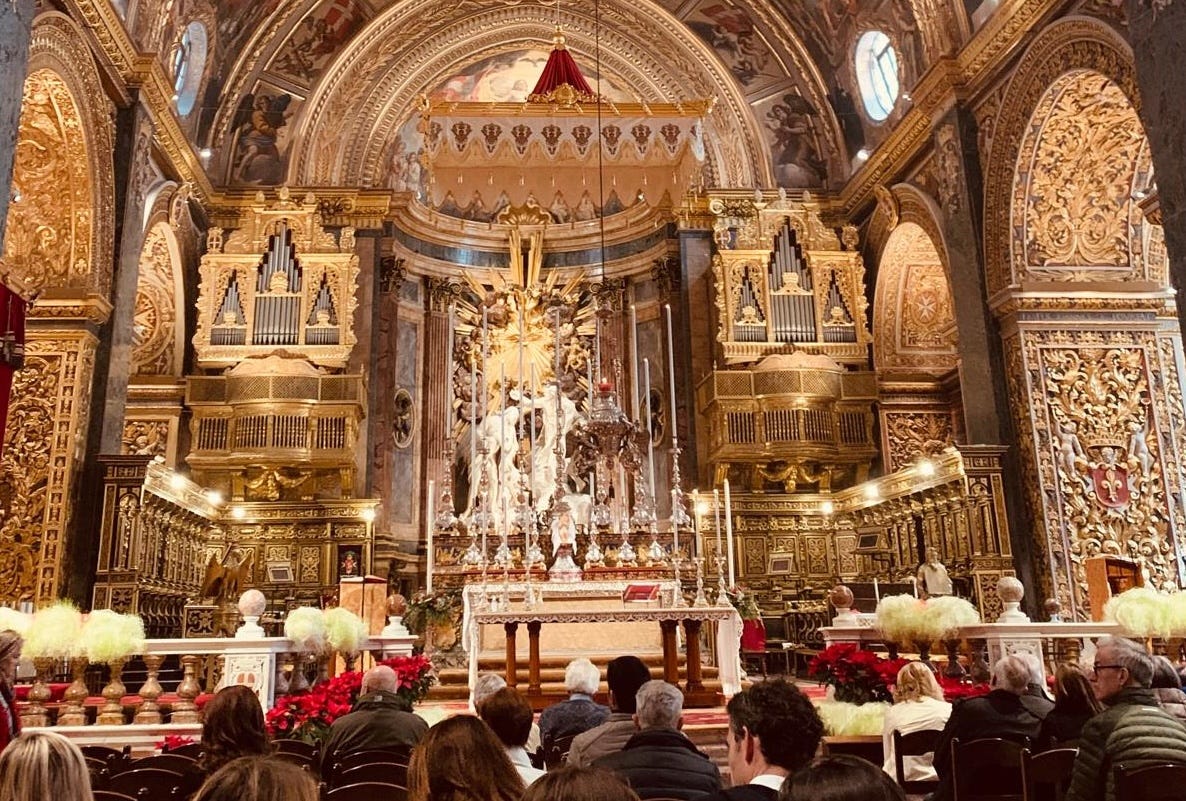
I’m not Roman Catholic and I don’t understand a word of Maltese. And yet Christmas Day mass at Valletta’s St. John’s Cathedral was an utterly charming experience, not least as attending a service saves you the €15 entrance fee otherwise charged to admire the super interior. We were also treated to a Maltese version of Hark! The Herald Angels Sing (not just the best carol ever written but one of the greatest songs ever written) and several blasts of the cathedral’s magnificent organ.
As Christmas Day’s go, it was a splendid start.
—
The decision to spend Christmas in Malta owed as much to a long-standing wish to once again visit an island on which I spent many happy holidays as a child as it did the desire to escape from a cold and damp Bucharest. We were broadly lucky with the weather—while it could have been warmer, on most days the sun shone brightly and it was possible to eat and drink outside.
Malta is not a winter beach destination, however. Average December temperatures hover around the 18°C mark, and the sea is far too cold to swim. (It could be argued of course that Malta is not a beach destination at any time of year—sand is a precious commodity in these parts, with most bays made up of rocks and crags. If you are looking for wide stretches of golden sand this is not the place for you).
Indeed, Malta is now a city break destination as much as anything else—a fact demonstrated by the thousands of visitors who had also made this their Christmas destination of choice. Valletta was packed every day. Buses to and from the capital were often full, and finding a place anywhere on the island that had a free table for Christmas lunch became a full-time job.
Fortunately, d’Centre, a lovely local restaurant in Birgu, one of the famed Three Cities opposite Valletta, took us in, and rewarded us with lobster tortellaci, roast turkey and roast beef. We eschewed the local speciality, rabbit.
—
Getting to Birgu is fun. You can, of course, take a bus or Bolt, but the best way is to jump on the ferry that crosses Malta’s Grand Harbour, landing at Cospicua (the second of the Three Cities. The third is Senglea). From there, it’s a short uphill walk past St. Lawrence’s church to the narrow streets of Birgu itself, with Fort St. Angelo and its unrivalled views of Valletta at its upper reaches.
The yachts in this part of Malta are as enormous as the churches, secular displays of wealth flying flags from across the world.
—
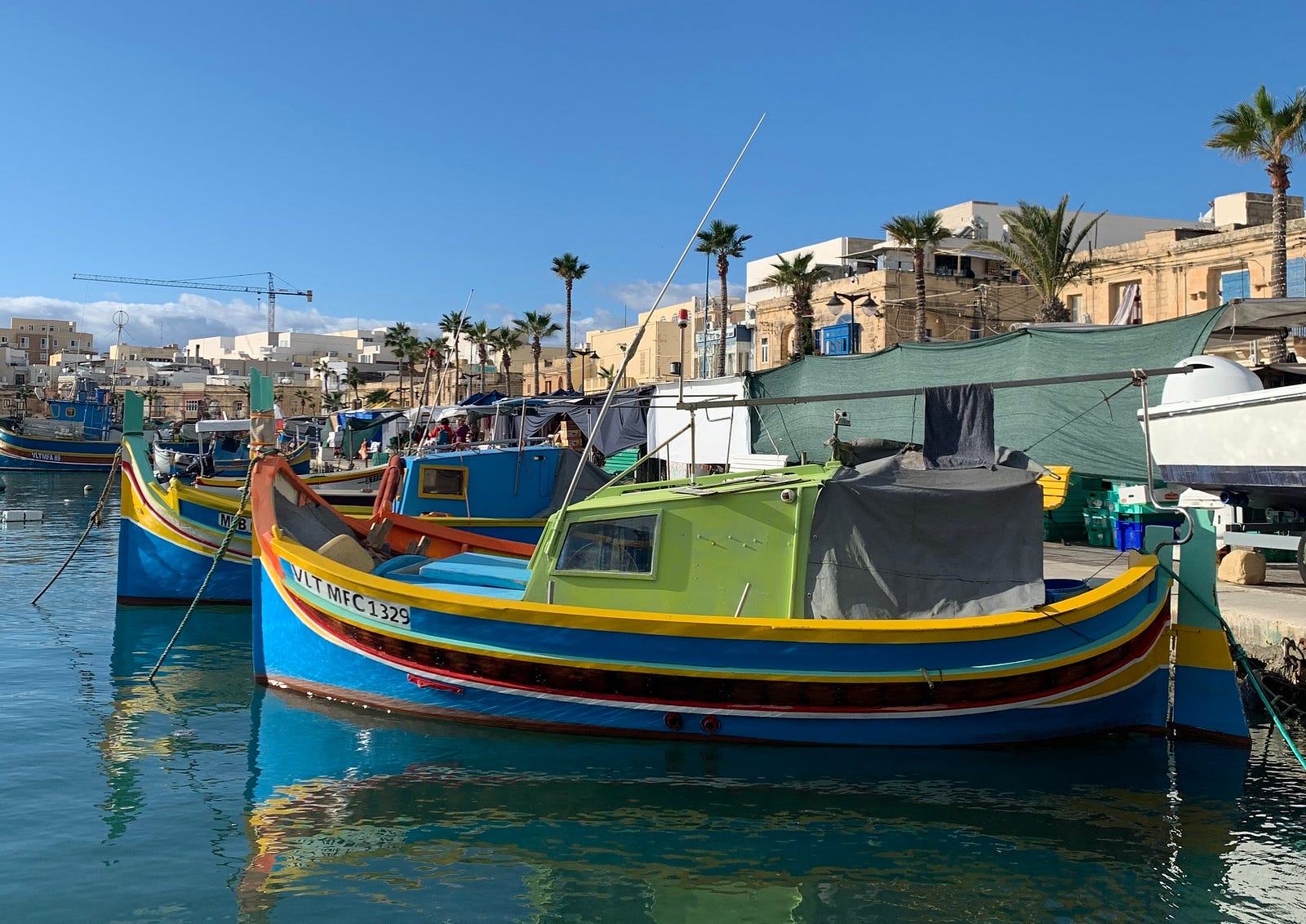
Boats of much smaller dimensions are to be found in the fishing village of Marsaxlokk on Malta’s south-eastern coast. Each Sunday morning the waterfront hosts a fabulous market where fishermen sell their fresh catch alongside pastries, cakes, sweets and bric-a-brac. Cafes overflow with locals drinking their morning espressos—all very Italian, as is much of the island’s culture.
Indeed, while the red post boxes, three-point plugs, terrific fish and chips (none better than at Alka near the Blue Grotto), and the fact that Maltese drive on the left are evidence of more than 150 years of British rule, Malta feels far more Italian than British. Even Maltese, the only Semitic language written in the Latin alphabet, contains many an Italian borrowing.
—
Valletta, perhaps because of its small size (it is home to no more than 25,000 people), is rarely mentioned in the same breath as other great European capitals, but it no doubt should be. Few places can rival its history and strategic importance. It’s an imposing city, entered through its medieval walls. Originally built in the 16th century, the City Gate has been reimagined in recent years to preserve its historical significance while ushering visitors into what feels at once like both a historic and very modern city. (It will also make a convenient ‘turnstile’ should the city go the Venice and Dubrovnik route of charging for entry—given the sheer number of visitors, it arguably should).
Beyond the gate, the view opens onto a broad walkway (Republic Street) which, straight as an arrow, leads all the way to Fort St. Elmo at the end of the peninsula. St. John’s Cathedral, where we celebrated Christmas, is Republic Street’s highlight, its relatively modest exterior belying a richly decorated interior bursting with gilded Baroque artistry.
Valletta’s tightly knit grid system however warrants exploration beyond the main street. Here, artisanal shops offer locally crafted goods, such as Maltese lace and filigree jewelry. Hidden churches, traditional wooden Maltese balconies, colourful doors and small bistros serving rabbit stew await.
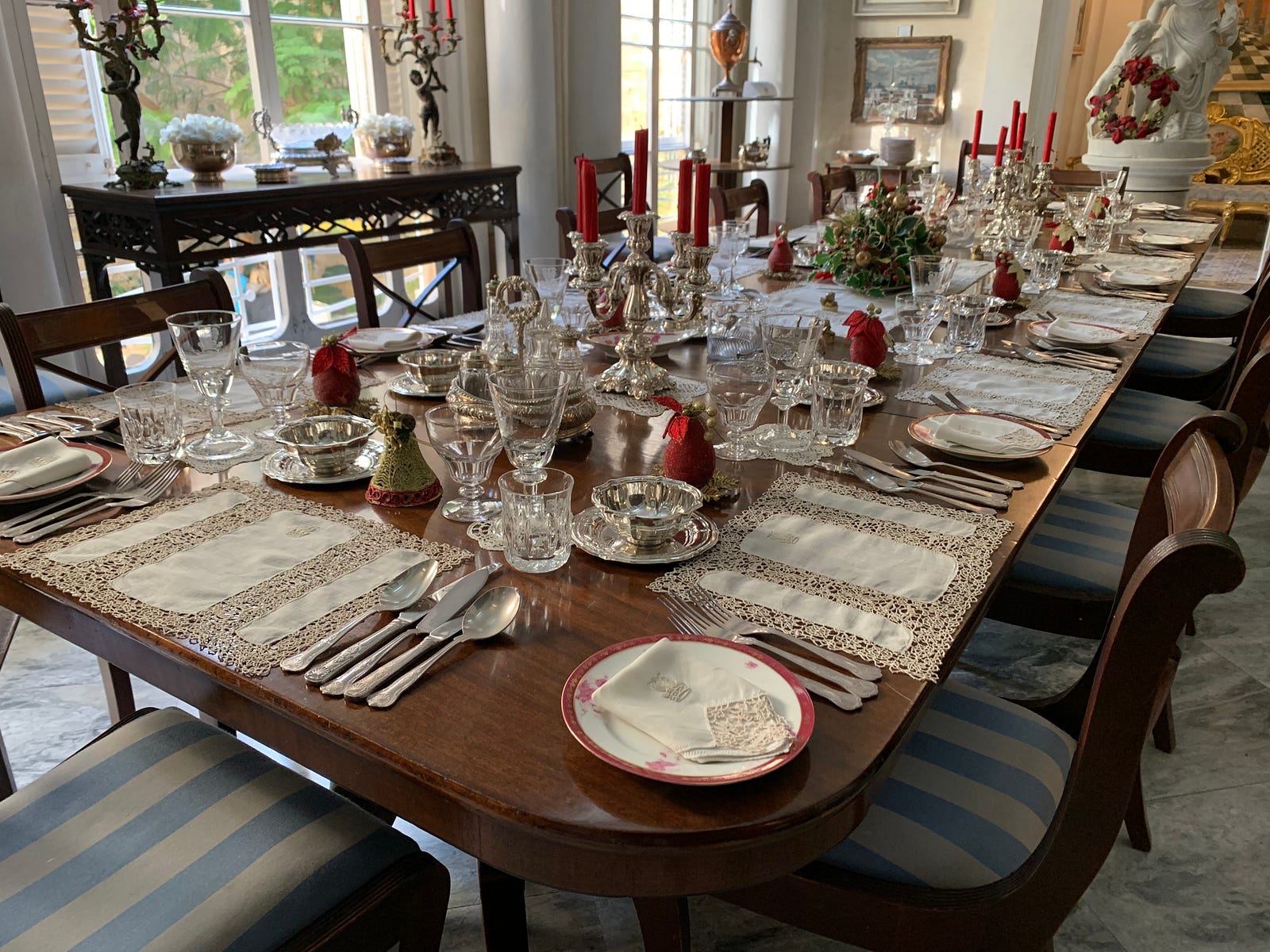
Quite the finest of many museums in Valletta is the Casa Rocca Piccola, a 16th-century palace still home to its owners, who live on an upper floor. It feels less like a museum and more like a cherished home brimming with character. As you wander through sumptuously decorated rooms (tables laid for gala dinners), admire the centuries-old art and heirlooms that offer a glimpse into Maltese aristocratic life.
Underneath the palace are more treasures, including WWII air-raid shelters carved deep into the bedrock—a testament to Malta’s wartime resilience. Outside, a charming courtyard garden provides a quiet sanctuary, its leafy walls whispering historic secrets.
—
Home for our week in Malta was a small apartment in Gzira, just a few minutes on a bus from Valletta. Not by design, the apartment was quite literally a kick of a football from what remains of Malta’s historic Empire Stadium.
It was infamous for its gravel pitch—the last gravel pitch to host international football in Europe. I was lucky to see a couple of games here, featuring John Holland and Raymond Xuereb’s Floriana side. Most memorable of all was an international my father brought me to in spring 1981, Malta v GDR. Malta scored first but the East Germans had obviously taken their meds and ended up winning 2-1.
It was (I think) the last international played at the stadium. The next time I watched Malta, a 3-2 defeat to Spain in 1983, was at the new but soulless Ta’ Qali Stadium.
—
We passed Ta’ Qali on the way to Mdina and Rabat, twin cities in the centre of the country both with equal but very different charms. Mdina is a beautifully preserved citadel, Rabat (as if nominally determined) a very north African place full of lovely shops, bakeries and cafes. It’s also home to one of Malta’s many impressive series of catacombs.
—
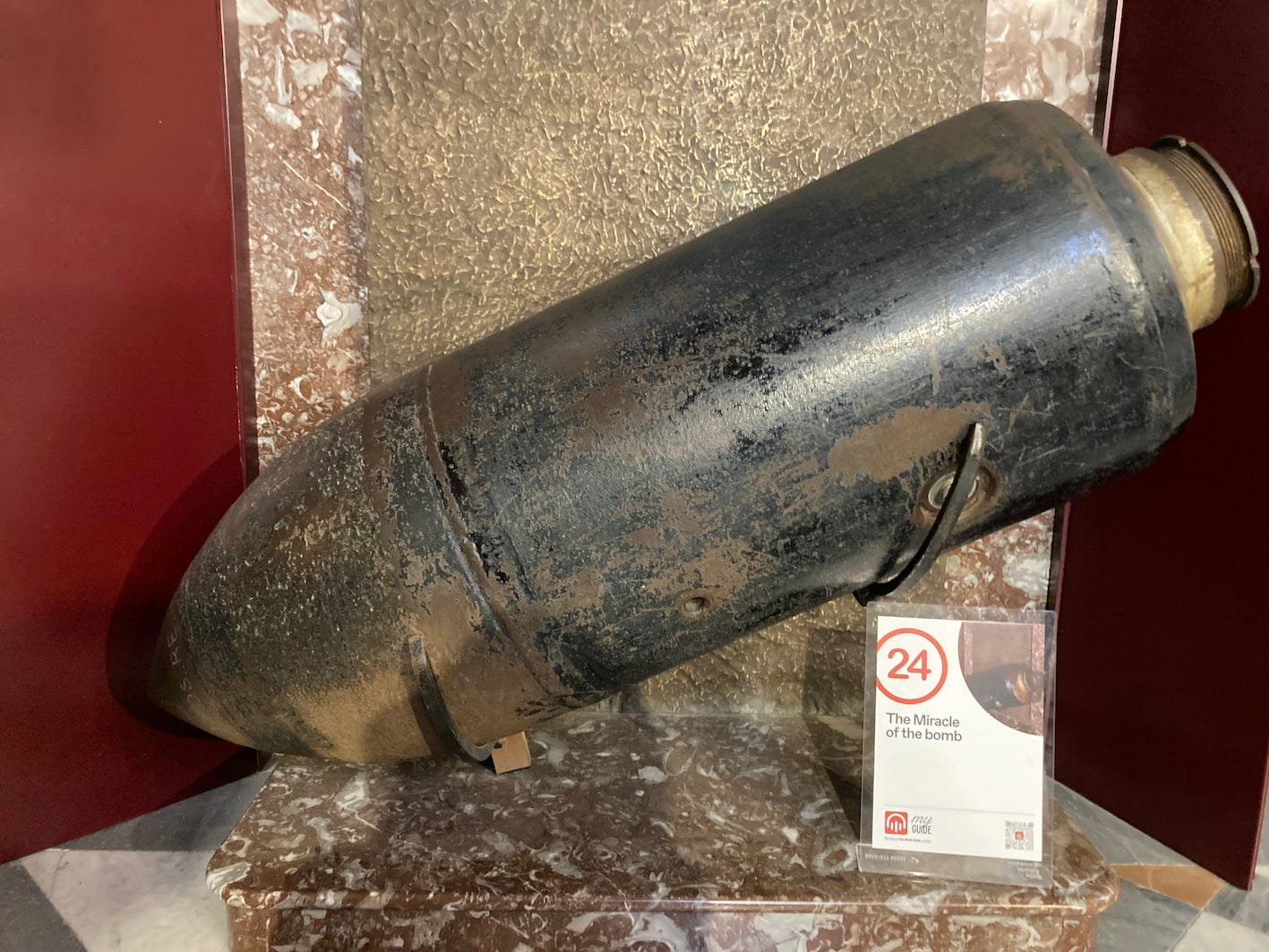
On April 9, 1942, a German bomb pierced the dome of the neoclassical rotunda at Mosta and fell into the church during mass, but failed to explode. It was, believers declared, a miracle. A replica of the bomb can be seen in the church today.
Narrow steps can be climbed to admire the dome of what is Malta’s largest church (and the third-largest unsupported dome in the world). An unpainted patch of the dome shows where the bomb made its entrance.
Underneath is a small museum telling the story of Malta during World War II. Strategically crucial, the Axis powers in 1940 set out to bomb and starve the Maltese into surrender. The island was one of the most intensely bombed theatres of the entire war. The siege was lifted in 1942, and the island collectively awarded the George Cross for bravery. The cross was incorporated into the flag of Malta in 1943 and remains on the current design of the flag.
—
Gozo is often said to be Malta in miniature. But the second largest of the Maltese islands (and one of only three to be inhabited; Comino is the other) has a charm and character of its own. Reached by ferry (€9 return) from the northern tip of Malta or (in good weather) catamaran from Valletta (€12 return) the island’s history is as rich as that of Malta.
It’s home to Ġgantija, a megalithic temple complex from the Neolithic era (c. 3600–2500 BC), the earliest of all the Maltese megalithic temples. (Others can be found at Tarxien and Ħaġar Qim). All three feature in Graham Hancock’s controversial Netflix series Ancient Apocalypse, which claims that there was an advanced civilisation during the last ice age, destroyed as a result of meteor impacts around 12,000 years ago. Maltese archaelogists have largely debunked Hancock’s theory.
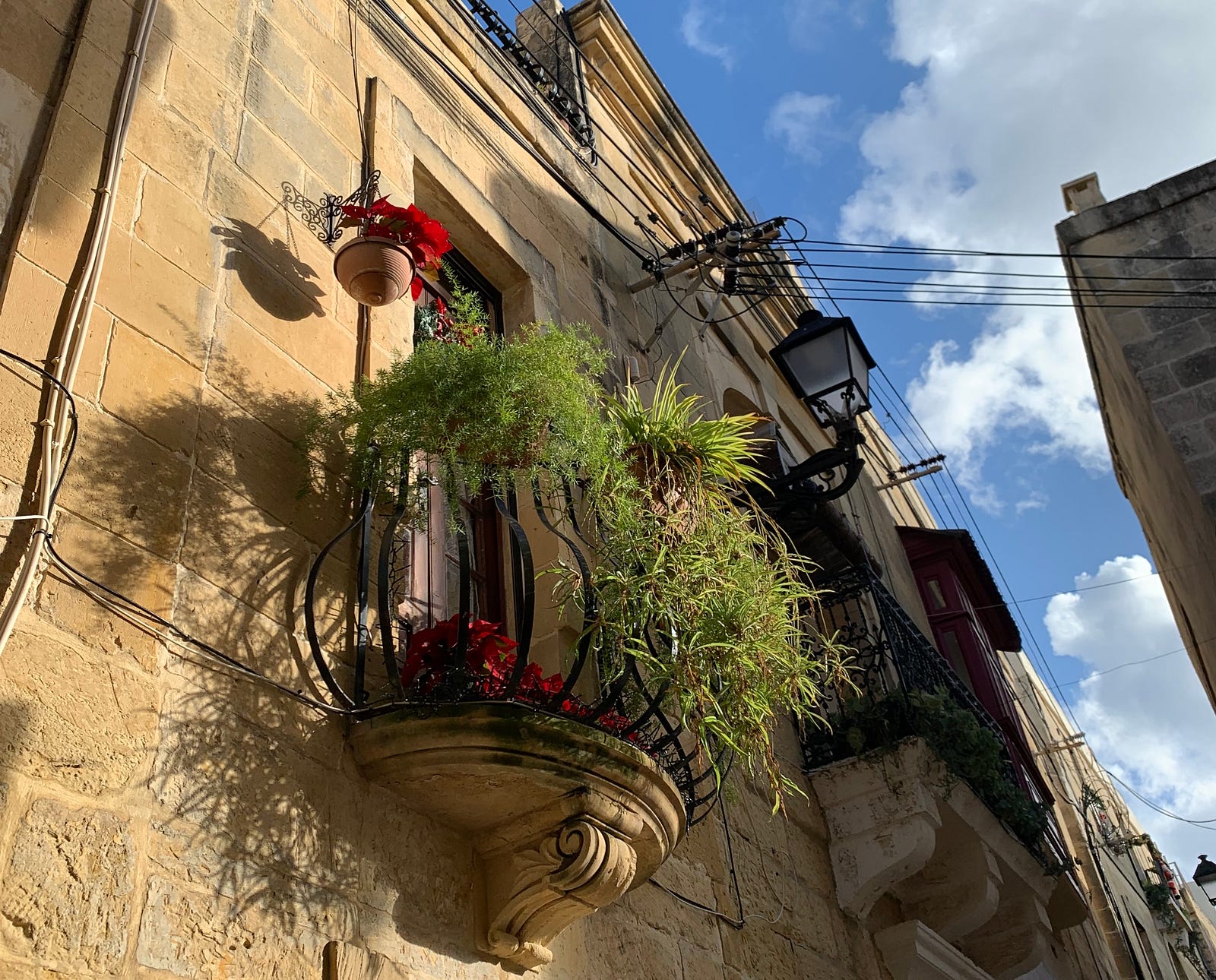
Gozo’s capital Victoria (or Rabat) is a lovely place, its streets as picturesque as Valletta’s and refreshingly free of crowds. Its citadel is splendid.
On the coast, Xlendi Bay is perhaps the prettiest of all the fishing villages in the Maltese archipelago.
—
Notes
Malta is small. Just about everywhere on the island is accessible by bus. A seven-day ticket valid on all bus routes (including those to and from the airport) costs €25. Single tickets cost €2 during the day, €3 at night.
Buses to and from Valletta can be very crowded—so crowded in fact that drivers will at times not let passengers climb on board. More than once we resorted to using Bolt. Prices are relatively cheap (a trip from Gzira to Marsaxlokk cost €9).
Malta has just one airport, at Luqa in the centre of the island. It’s small but very efficient, having recently installed security scanners which negate the need to remove liquids and laptops from luggage.
Food on Malta is dominated by rabbit and seafood, all with a heavy Italian influence. Try the local swordfish and fresh tuna. Brits looking for a full English or fish and chips will not be disappointed, however. Vegans could struggle.
—
We visited (not a definitive list)
Valletta
Birgu
Rabat
Mdina
Blue Grotto
—
We ate at (again, not a definitive list)
d’Centre (Birgu)
The Smokehouse (Gzira)
Anciova (Gzira)
Alka (Blue Grotto)
Cafe Jubilee (Victoria)