15 September 2023
In search of summer snow
Or, Around Austria by train
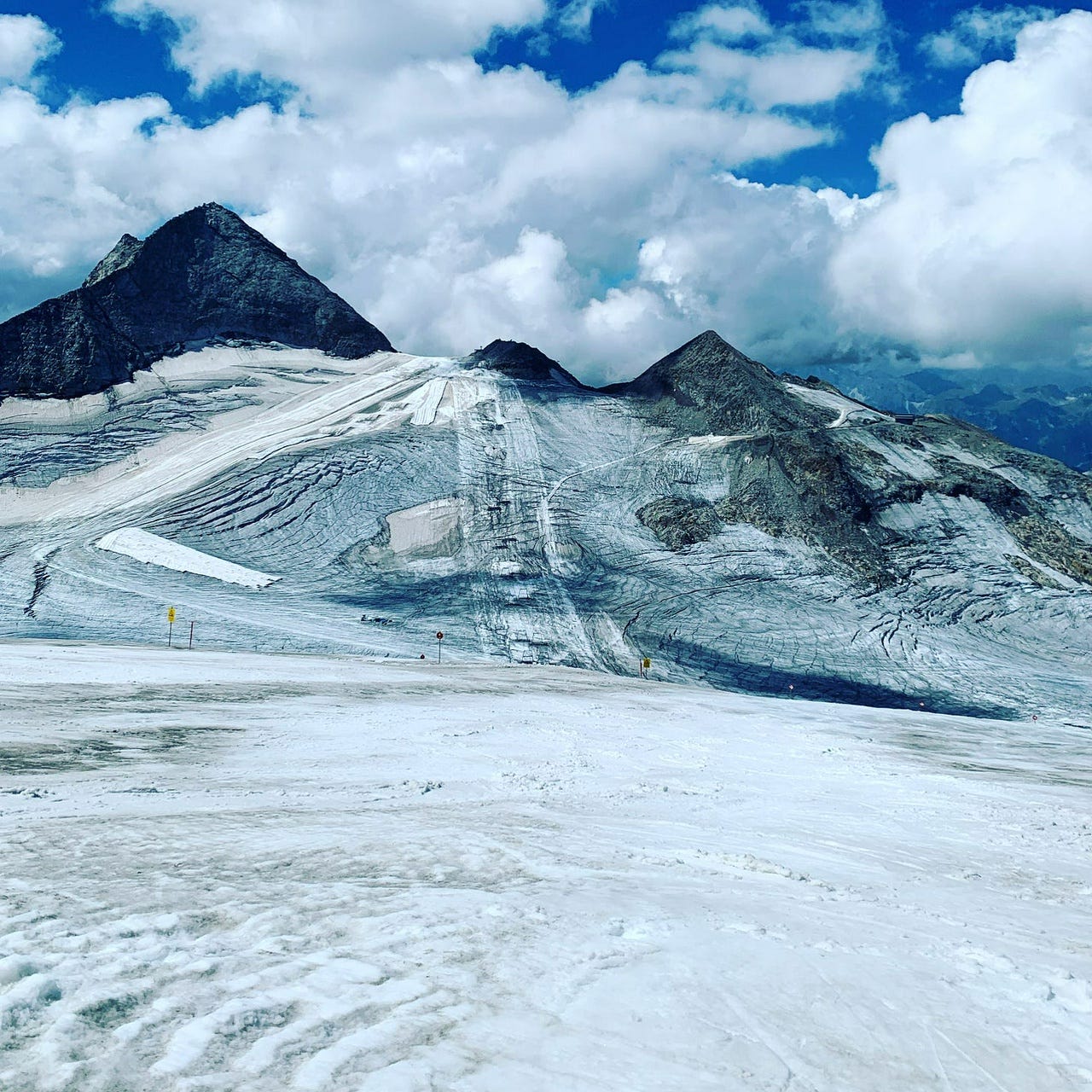
Europeans wishing to ski in high summer have two options: an Alpine glacier or a bank-busting trip to the Southern Hemisphere (Portillo in Chile comes highly recommended. One day, one day…) Lacking a Southern Hemisphere budget, it was the glacier option that I last August decided to take in order to celebrate my 50th birthday on snow.
Or ice, as it turned out.
There were once a dozen or so high altitude European ski areas which offered year-round skiing. Most, as a direct consequence of climate change, have in recent years been forced to close in mid-June, before reopening again in October. Just a handful of resorts continue to offer skiing throughout July and August, including Les Deux Alpes in France, Zermatt and Saas Fee in Switzerland, and Hintertux in Austria. In Italy, Passo Stelvio ski resort opens only during summer.
Snow conditions at Europe’s glacier resorts in July and August depend on two factors: the amount of snow that fell the previous winter, and the temperature. On both counts, I couldn’t have picked a worse August to try summer skiing. The 2021-22 winter season had been poor across much of the Alps, which, when combined with record high temperatures throughout June and July, meant that the glaciers lost their snow cover much earlier than usual. Indeed, by the time I left for Austria at the back end of August, every European summer ski area had closed to the public except for Hintertux. (Saas Fee remained open in extremely difficult conditions for national ski team training).
That Hintertux stayed open at all had by the time I arrived become something of a national scandal in Austria, with environmentalists calling for its closure. They were right. The one piste that had been kept open (in order to allow the resort to continue with its claim that it offers ‘365 days per year’ skiing) was covered at the top in the thinnest layer of snow. Halfway down the snow disappeared, leaving just the thinning, black glacial ice. Though I did take the three cable cars required to reach the glacier, I didn’t ski it.
My lifelong ambition to ski on my birthday will have to wait for another year; my 60th perhaps. By that stage, I have serious doubts if there will be any skiing at all between June and October in Europe.
Chile it is. I should start saving now.
—
Fortunately, skiing was not the be all and end all of the trip. There were trains to ride, lots of them.
Hintertux sits at the top of the Ziller Valley but is strictly a ski station rather than a resort. Beyond the ski lifts, one (very expensive) hotel and a couple of restaurants there is little there. As such, we decided to base ourselves in Mayrhofen, a gorgeous little town which I first visited in 1984 on a school skiing trip.
From Vienna, to where we had flown the previous evening from Bucharest, we reached Mayrhofen on three trains: Vienna to Worgl, Worgl to Jenbach, and then Jenbach to Mayrhofen on the Zillertalbahn, a narrow guage railway that rattles and winds its way along the Ziller Valley. Mayrhofen is the end of the line. (Buses run to villages beyond, as well as to the Hintertux base station).
We left Vienna Hbf shortly before seven in the morning and arrived at Mayrhofen in time for a late lunch. Our accommodation was a simple yet perfectly located central apartment, the Gästehaus Valentina, a short walk from the railway station. Breakfast was included. (When we left a couple of days later we did so early in the morning and the wonderful owner insisted on providing us with a packed breakfast for our trip).
We spent our first afternoon in Mayrhofen stretching our legs with an agreeable amble up to the Alpengasthof Wiesenhof at 1,056 metres. (Mayrhofen itself sits at 633 metres). The views from its terrace are fabulous, although by the time we arrived the cook had gone home, meaning that it was drinks only. On arrival back in the town, famished, we ate on the terrace of the Gasthof Perauer. Not for the first or last time in Mayrhofen, I ate the Gröstl—fried bacon, onion and potatoes topped with a couple of fried eggs.
The next day had been pencilled in for skiing. Despite already knowing full well that snow conditions were, to say the very least, poor, the weather when we woke up was sunny and warm, so we decided to make the trip to the top of the glacier anyway, in order to see just how awful the situation was.
To reach the Hintertux glacier, at 3250 metres, from the base station at 1400 metres, the full trip takes about 35 minutes. There was no snow to be seen until we reached the top of the second cable car, at 2700m. Even at this height there were just a few patches, certainly nowhere near enough for skiing.
Onwards and upwards, it was only at the very top of the third lift that the landscape took on a vaguely wintry look. During a ‘good’ summer, there are 20km or so of pistes on which to ski up here, served by several lifts. At the end of August 2022, there was just that one open piste (half of which, as I say, was sheet ice) and one working lift.
Determined to make a day of it, we decided to walk down the mountain. A mistake, as it turned out. It took hours, and was tough on the knees.
The next morning, we were up before dawn to take the first train back to Jenbach. From there, we jumped on another service to Salzburg. This particular train would be the only delayed service of the trip. Why? Because it travels through Germany, where it sat, motionless, for 45 minutes. ‘A police emergency,’ we were told.
Salzburg’s lovely, but then you likely know as much. The hills are alive, particularly on summer Saturdays, with more tourists than the city can cope with. Venice is about to start charging day trippers. Other cities are watching and waiting. If it works we will likely see similar schemes deployed elsewhere. I can’t help thinking that dynamic pricing would work well: when a city is near capacity a visit becomes so expensive would-be tourists decide against it.
(This idea is perfect for Venice, or Dubrovnik, with neat and tidy entrances and exits. For more expansive places, the logistics, I’ll admit, need work. But the idea is sound).
From Salzburg we travelled to Graz, one of Austria’s lesser lights but great for a day or two. Its main attraction is its castle (accessed by a terrific funicular, rail fans), as well as the bold (or hideous, depending on your view) Museum of Modern Art. Personally, I like it.
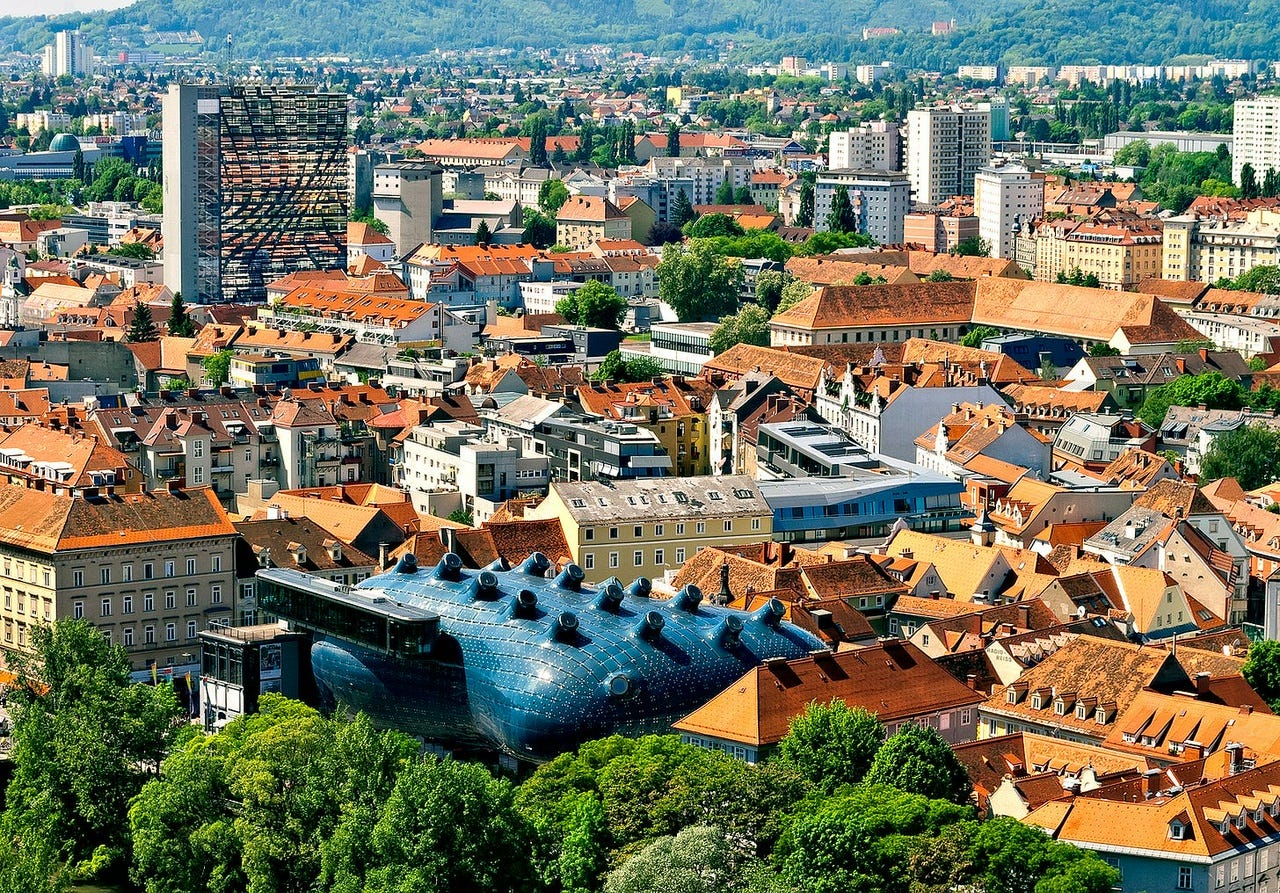
Home in Graz was the InterCity Hotel next to the station (I did warn you that this was a train-themed trip). The walls are decorated with transit maps.
From Graz we headed back to Vienna, via the Semmering railway, built over 41km of high mountains between 1848 and 1854. It’s as wonderful as advertised. A tunnel, currently under construction, will reduce journey times considerably, but the sensational views of one of the loveliest parts of Austria will be lost. You have until 2030 (when the tunnel is due to open) to ride Semmering, if you haven’t already.
Little I could possibly tell you about Vienna will be new and interesting, so I shan’t bother, although I will point you towards the House of Music, not usually first on any visitor’s list but really the most innovative, fun, informative and brilliant museum I’ve been to in a while. (Or it was, until I visited the new and even more impressive Hungarian House of Music this summer).
Forget sausage and schnitzel by the way in the Austrian capital (although if you can’t resist, Figlmueller is my pick, better—and slightly cheaper—than the more famous Zum Schwarzen Kameel). It’s the zillions of little places serving food from around the world, cooked and served by a legion of migrants, you need to head for. (In spite of its awful current government, Austria—Vienna especially—is heartwarmingly multicultural). Mama’s Ramen (Ballgasse 5) is cheap and tasty. There’s a Romanian restaurant opposite, Bukowina.
Notes
Few railway operators make booking tickets and reserving seats as easy as Austria’s ÖBB. Its online platform is a joy to use, with all route, time, type of train and price options clearly shown on one page, ensuring that you will not be fooled into booking a more expensive ticket than you need. Much like ÖBB’s trains themselves the site is a model of how things could, and indeed should be.
There are no booking fees, and tickets (in the form of a barcode or QR code) can be stored in ÖBB’s app. You do not need to print them. Look out for non-refundable sparschiene (saver) tickets. These are the cheapest, offer amazing value and while limited in number they are almost always available on all but the busiest trains (even just a day or two in advance: we purchased sparschiene tickets from Graz to Vienna just three days before departure).
Had time allowed, we would have travelled all the way from Bucharest by train, using the Dacia Express which leaves Bucharest Nord at 14:50, arriving at Vienna Hbf at 08:21. (The withdrawal of the Dacia’s dining car, however—replaced with a bar selling snacks and drinks only—has made this train a less attractive option).
We stayed at
Vienna
Not the best location but a very good hotel for the money.
Not exactly central but close to the S-bahn that serves the airport (which we needed to catch early in the morning).
Mayrhofen
Fairly basic B&B but the owner’s great and the location is perfect.
Graz
It’s next to the station and has transport maps on the walls of the rooms. What more do you want?
We ate at (not an exhaustive list)
Vienna
Mayrhofen
Salzburg
Graz
We visited (again, not an exhaustive list)
Vienna
Mayrhofen
Salzburg
Graz