30 November 2024
Postcards from the Silk Road
Or, In search of Uzbekistan’s best plov
It’s lunchtime at a busy conference centre in the Uzbek capital Tashkent. A local bemoans the quality of the food being served. This isn’t plov, he says, and begins to explain how Uzbekistan's ubiquitous dish should be carefully layered with rice, carrots, peppers, chickpeas and either beef or lamb on top. The version we’re eating resembles biryani. They clearly have no idea what they are doing. Come with me to Samarkand, I’ll show you some real plov.
Two days later I am on an early morning train from Tashkent to Samarkand. It’s some train. Known as the Afrosiyub, it’s been in service since 2011 and is the fastest train in Central Asia. A digital display informs me of our speed, which tops out at 190 km/h.
The Afrosiyub makes the 350-kilometre run from Tashkent to Samarkand in just over two hours. Previously, the journey took over five. On slower trains, it still does.
Prices for the Afrosiyub are relatively cheap, just 190,000 som (around 16 euros) for a one-way trip in VIP class, half that for economy. Tickets are hard to come by, however, and often sell out weeks in advance. In all classes, complimentary drinks and snacks are served by staff in crisp, immaculate uniforms. The train is impeccably clean, as are the stations – impossible to enter if you are not in possession of a valid ticket. Airport-level security enforces the rule.
At Samarkand station (which looks remarkably like Tashkent’s, and Bukhara's, and Khiva's, as well as Tashkent’s domestic flight terminal and Bukhara airport, as if they were all bought in a cut price deal) I am greeted by my guide for the day: my new friend from the conference centre in Tashkent.
A chilly November morning, Samarkand is free of the heat, dust and tourists that can make visiting during the warmer months a chore. Even Registon Square, the jewel in Samarkand’s crown and star of every Uzbek travel commercial, is devoid of crowds. Only a few parents watching their children rehearse a performance ahead of Uzbekistan’s flag day break the blissful silence.
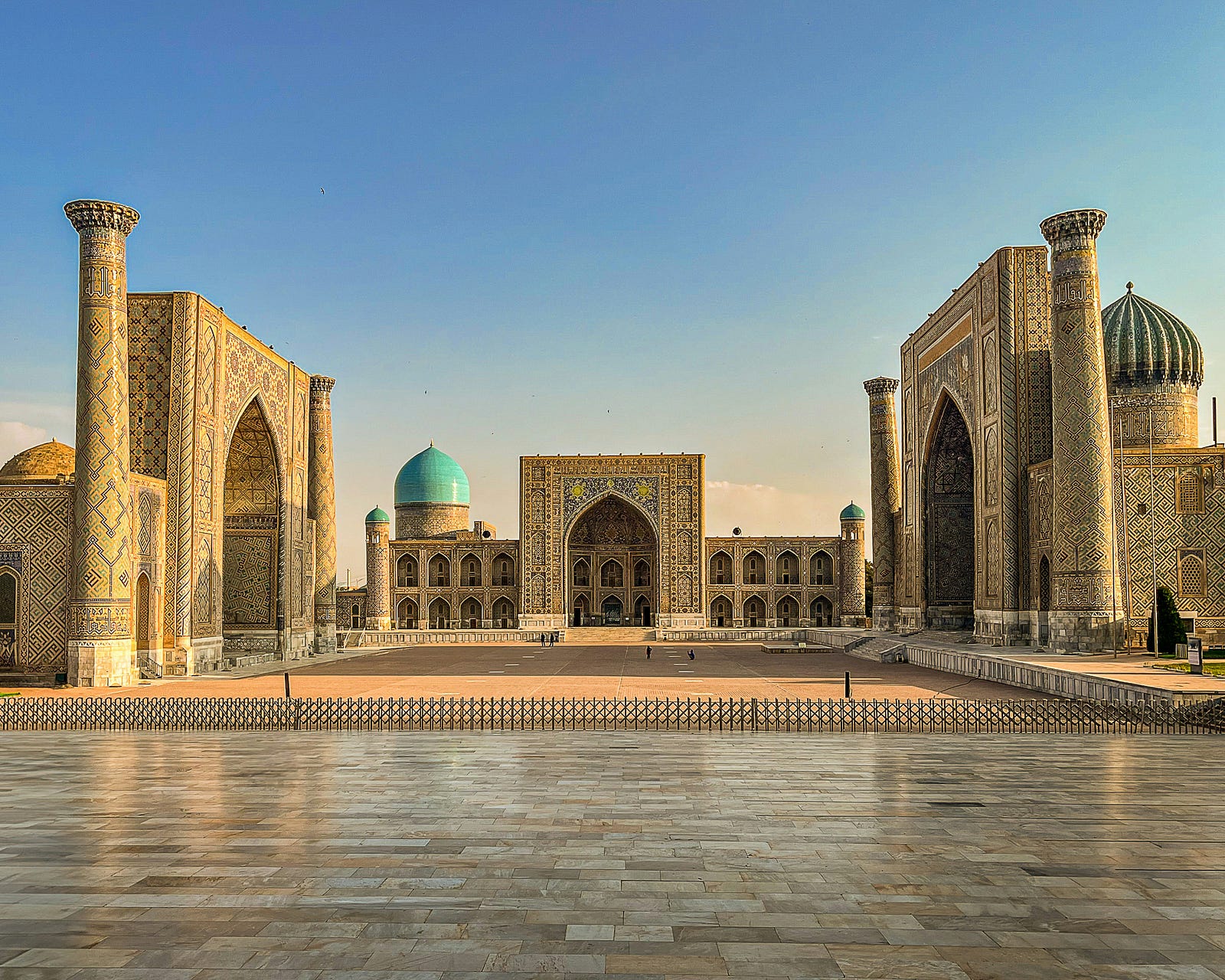
Later, I visit the Shah-i-Zinda necropolis, and have it (almost) to myself. It’s genuinely one of the most stunning places I have ever been fortunate enough to visit, the beautifully tiled tombs, all bright blues and arabesques, at once elaborate yet delightfully simple. I spend hours here reflecting, thinking, photographing.
There’s more treasure at the early 15th century Amir Timur Mausoleum. Timur was the begetter of the Timurid Empire, which covered much of modern-day Central Asia, Iran and Afghanistan. Undefeated in battle, Timur is widely regarded as one of the greatest military leaders and tacticians in history, as well as one of the most brutal.
Timur’s remains were exhumed on the orders of Stalin in 1941, defying a curse inscribed on the tomb that warned, When I rise from the dead, the world shall tremble. Two days later, Nazi Germany began its invasion of the Soviet Union. Stalin ordered the remains reburied, although not before Soviet scientists had been able to create a reconstruction of Timur’s facial features.
Next, the enormous Bibi-Khanym Mosque. Timur would allegedly interfere frequently in its design, causing delays that meant it was not complete by the time of his death in 1405. As my guide tells me of Timur’s constant meddling, I can’t help thinking of Romania’s Nicolae Ceaușescu, who micromanaged the design and construction of Bucharest’s ghastly Palace of the People.
Tyrants they might both have been, but Timur clearly had infinitely better architectural taste. Who will still be visiting Ceaușescu’s monstrosity 600 years hence?
Opposite the Bibi-Khanym Mosque is Samarkand’s largest market, the Siab Bazar. Noisy and chaotic it’s everything you hope an Uzbek market would be. Spices, nuts, and bread abound. I buy naan for the trip back to Tashkent, and kilos of tiny yet delicious Uzbek pistachios.
—
But before I leave Samarkand, I want my plov, that real, genuine, Samarkand plov. My guide brings me to a place that declares itself, in Cyrillic lettering, to be Центр Плова. Plov Centre. I think I am in the right place.
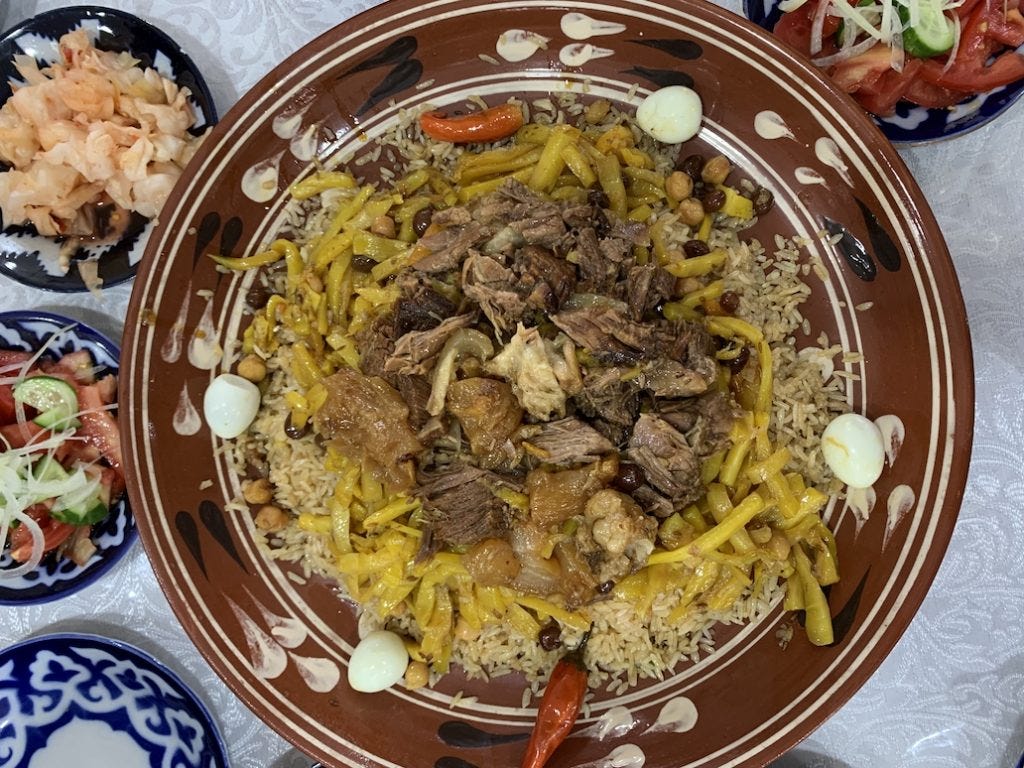
It’s packed, but we grab a couple of seats at a shared table. Pots of strong tea are placed on the table before we’ve even taken off our coats. Then come meze, spreads, bread, followed by the plov. It’s just as I was promised, a layer cake of perfectly cooked rice, carrots, peppers and chickpeas, topped here with the most delicious, tender beef.
After a full day pounding Samarkand’s ancient streets, it’s almost time to leave. But having by now realised from my incessant questioning about the Afrosiyub train that I’m something of a transport buff, my guide promises me one final, most modern of surprises in this oldest of cities: Samarkand’s brand new airport.
Opened in April 2022, Samarkand International Airport fortunately looks nothing like its Tashkent or Bukhara brethren. Its exterior resembles an open book, the design inspired by the New Guragan astronomical tables, a manuscript published by the 15th century Uzbek astronomer, Mirzo Ulugbek. At night, its roof lights up with depictions of the constellations Ulugbek discovered, visible as planes make their final descent.
Samarkand Airport, together with a large tourist and conference complex just outside the city, was built at a cost that some estimates place at around $800 million, half of which came from private investors and half from the Uzbek government: one of the first public-private partnerships in the country’s history, and a sign, perhaps, that the current government is serious about liberalising the economy.
With a capacity of two million passengers per year, it will allow visitors to access the Silk Road cities without first travelling to Tashkent (for as one Uzbek confided in me, If I were to list the 10 best sights to visit in Uzbekistan, Tashkent does not make the list. I disagree: parts of Tashkent's metro system are stunning: see below).
As I take photos of the empty terminal, a security guard grumbles and motions at me to show him my phone. I decline and exit quickly. It’s almost reassuring. I did not expect to find one of the world’s fastest trains in Uzbekistan, nor one of its most stunning airports. I did expect to find surly security guards, however. Oh, and plov.
—
My visit to Uzbekistan also included the opportunity to visit Bukhara (by plane from Tashkent, alas, not on the train, which was sold out). If Samarkand is Uzbekistan's crown jewel, then Bukhara is its beating heart—a city where the past feels so immediate you half expect to encounter a camel caravan around the next corner.
Bukhara's old city is a UNESCO World Heritage Site, and unlike many such designations, this one feels entirely justified. The Kalyan Minaret, dating from 1127, dominates the skyline just as it has for nearly a millennium. Genghis Khan supposedly spared it during his otherwise thorough destruction of the city, declaring it too beautiful to destroy. Whether this tale is apocryphal or not, the minaret certainly deserves its reputation—a soaring brick masterpiece that serves as a perfect focal point for the surrounding madrasa complexes.
The Ark of Bukhara, a massive fortress that served as the residence of Bukhara's rulers for more than a millennium, offers spectacular views over the old city. Climbing to its ramparts, you can see the entire layout of medieval Bukhara spread below—trading domes, madrasas, and minarets arranged in the organic pattern that characterises Central Asian cities.
What strikes you most about Bukhara, however, is how lived-in it feels. Unlike Samarkand, which can sometimes feel like an open-air museum, Bukhara remains a functioning city where people go about their daily business among monuments that have stood for centuries. Children play football in courtyards overlooked by ancient minarets, while elderly men gather for tea in the shadow of buildings that once hosted merchants travelling the Silk Road.
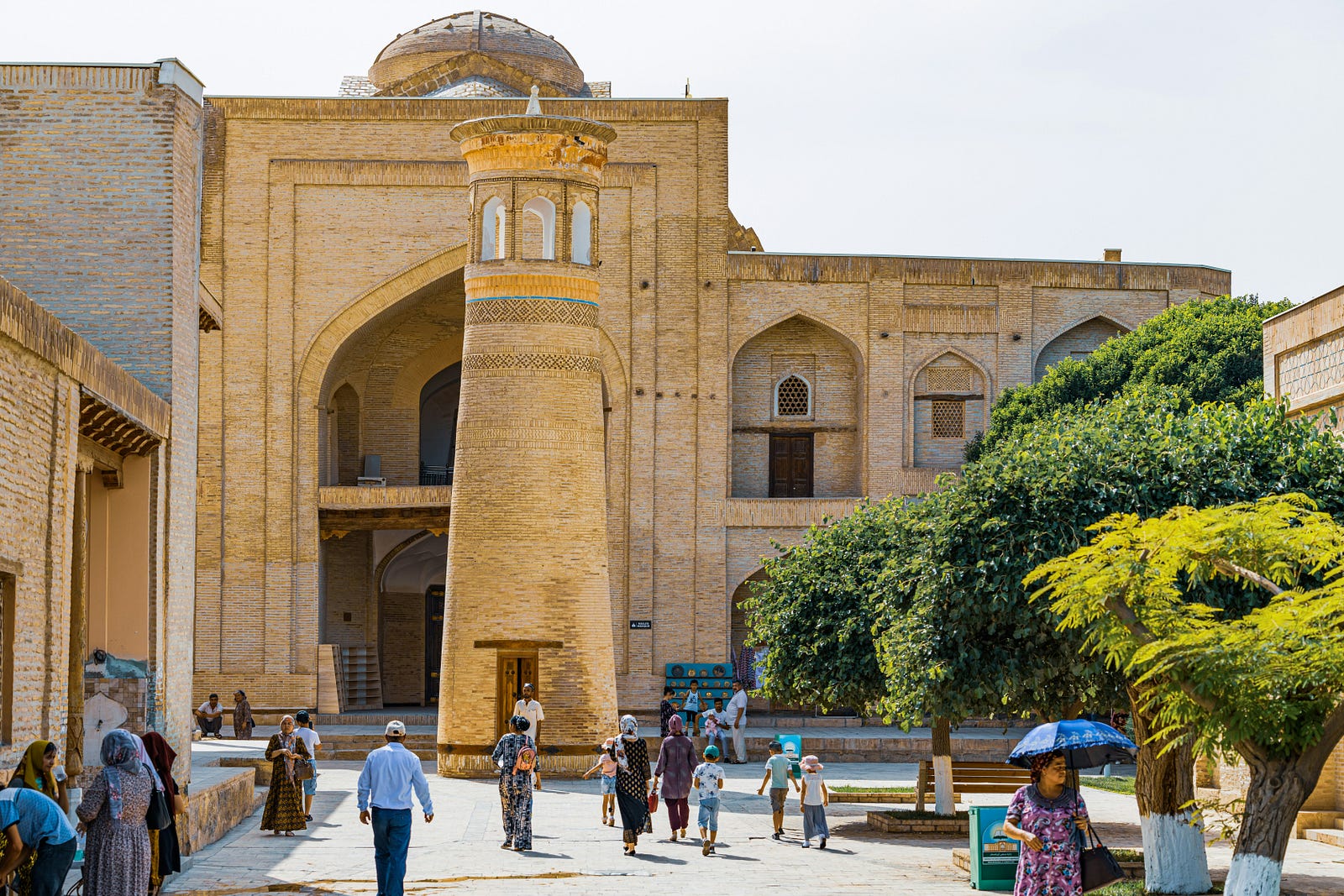
The trading domes—Taqi-Sarrafon, Taqi-Zargaron, and Taqi-Telpak-Furushon—still function as markets today, though the goods on offer have adapted to modern tourism. Carpets, silk scarves, and miniature replicas of famous monuments compete for space with genuine antiques and traditional crafts. The haggling is good-natured rather than aggressive, and the quality of the craftsmanship is genuinely impressive. Silk goods are usually the biggest bargain.
I spent an entire afternoon wandering the streets around the Lyab-i Hauz complex, a plaza built around an ancient pool that serves as Bukhara's social heart. Mulberry trees provide shade for the tea houses that surround the water, while the Nadir Divan-Begi Madrasa provides a spectacular backdrop.
—
My experience of Tashkent, by contrast, was frustratingly limited. As a delegate at a UNESCO conference, I found myself confined largely to a modern conference centre that could have been anywhere in the world—the kind of international hotel complex that exists in a hermetically sealed bubble, disconnected from the city beyond its gates.
The irony wasn't lost on me. Here I was in one of Central Asia's most intriguing capitals, attending sessions about cultural preservation and international cooperation, while seeing virtually nothing of the culture that surrounded us.
But I did manage one genuine Tashkent experience, and it proved to be extraordinary: the city's metro system. Built during the Soviet era and opened in 1977, Tashkent's metro is often described as one of the world's most beautiful underground networks, and the description is entirely justified.
Each station is a work of art in its own right. Alisher Navoi station features blue and white ceramics celebrating Uzbek literature, while Kosmonavtlar station pays tribute to the Soviet space programme with mosaics depicting rockets and cosmonauts. Pakhtakor station is perhaps the most spectacular of all, its ceiling decorated with cotton plants (pakhta means cotton in Uzbek) rendered in intricate mosaic detail.
The stations feel more like underground palaces than transport hubs. Massive chandeliers illuminate marble columns and geometric floors, while the platforms themselves are wide enough to accommodate crowds without ever feeling cramped. Until 2018, photography was strictly forbidden on the metro—today you shouldn’t have any problem.
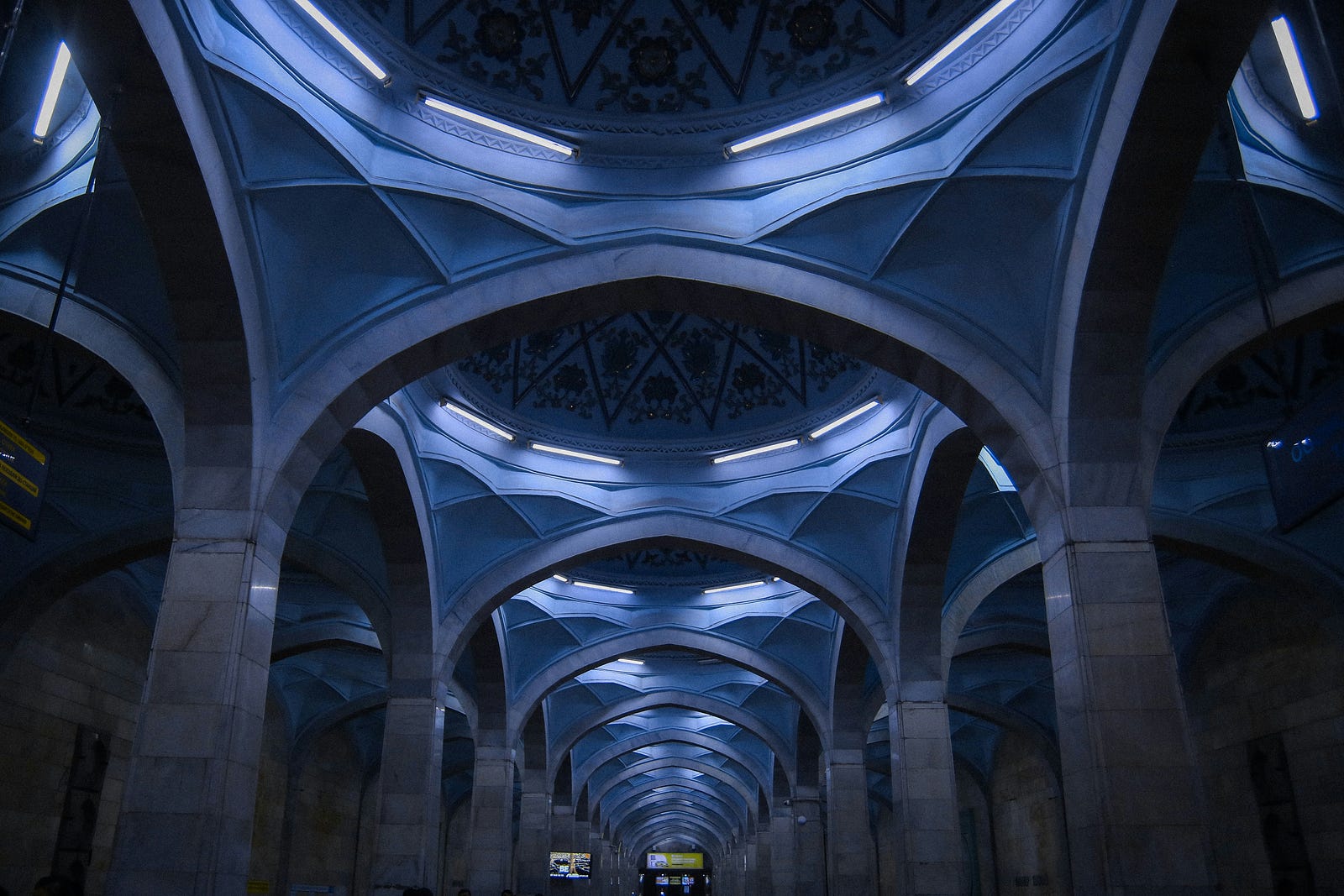
What's particularly remarkable is how well-maintained the system remains. Despite being nearly half a century old, the stations are spotlessly clean, the trains run precisely on time, and the original artwork has been carefully preserved. It puts many Western metro systems to shame—I couldn't help thinking of London's overcrowded, overpriced Underground.
The metro also offers a genuine glimpse into contemporary Tashkent life in a way that the conference centre never could. It was perhaps the most authentic Tashkent experience available to someone with just a couple of hours between conference sessions.
Indeed, standing on the platform at Mustaqillik Maydoni station, surrounded by marble columns and intricate mosaics, I reflected on how this brief underground journey had revealed more about contemporary Uzbekistan than two days of conference presentations.
Sometimes the most profound travel experiences come from the most mundane activities—in this case, simply getting from one place to another.
—
Notes
I flew to Tashkent from Bucharest via Istanbul with Turkish Airlines. Other options now include LOT via Warsaw. There are direct flights with Uzbekistan Airways from London.
I stayed at the perfectly adequate Courtyard by Marriott (a little too far from the centre of Tashkent for my liking, however).
The Afrosiyub train requires advance booking (here: beware agents who will charge a large commission), particularly during peak season. Tickets can be purchased online or at stations, but sell out quickly. Economy class is perfectly adequate for the two-hour journey but the VIP experience is terrific and not at all expensive.
Uzbekistan Airways connects Tashkent with Bukhara and Samarkand multiple times daily. Flights are short (around one hour) but lack the romance and efficiency of the Afrosiyub.
November proved an excellent time to visit Uzbekistan—pleasantly cool temperatures, clear skies, and minimal crowds. Summer temperatures can be brutally hot, attractions crowded, accommodation thin on the ground. Winter brings occasional snow and significantly colder conditions.
Photography on Tashkent's metro is now permitted, though some older staff may still show reluctance. The system operates from early morning until late evening, with trains every few minutes during peak hours. The flat fare is a bargain 2000 sum (around €0.15).
Uzbek hospitality is genuine and generous—accept invitations to share meals or tea whenever possible.