16 January 2026
Street food for gourmands
Or, Do we look like pensioners? A few days in Singapore
There are nanny states and then there’s Singapore. Cigarettes can be smoked in two places: at home or at designated smoking sections located in outdoor car parks. That’s it. Light up anywhere else and you’ll be fined.
Not that smoking is currently the number one concern of a country that rivals 1980s East Germany for its stance on personal freedom. No, it’s vaping, outlawed in its entirety (even outdoor car parks are vape-free) and the subject of a widespread public health campaign aimed at young people whose lives, should they not yet be miserable enough, get even worse at 18 when they are press-ganged into the army for two years with zero exceptions. Even professional footballers with contracts at Premier League clubs are forced to return to serve the all-powerful Singaporean state. One footballer told Singapore to shove its citizenship. Singapore told him he couldn’t.
Perhaps I’m being slightly unfair. Singapore is an incredibly efficient, well-run city that is impeccably clean and tidy, safe, friendly, and not as crowded or expensive (accommodation excepted) as often advertised. Singaporeans live longer than any other people on the planet. If that’s the price of freedom, maybe they consider it a worthwhile one. Booze is almost prohibitively expensive, as you would imagine.
Effectively a one-party state, housing gets doled out according to racial quotas, income levels and marital status. The number of cars is capped at around one for every ten people. You need a special permit to own one. The cost of vehicle ownership is therefore the highest in the world. But there are no traffic jams, and public transport is cheap and (at least in my experience) without equal anywhere in the world. For every sacrifice there’s an exchange Singaporeans appear to accept. No opposition? The government is so competent it doesn’t need one. Can’t own a car? Public transport is so good you don’t need one. Can’t smoke, vape, or drink? You’ll live a longer life.
–
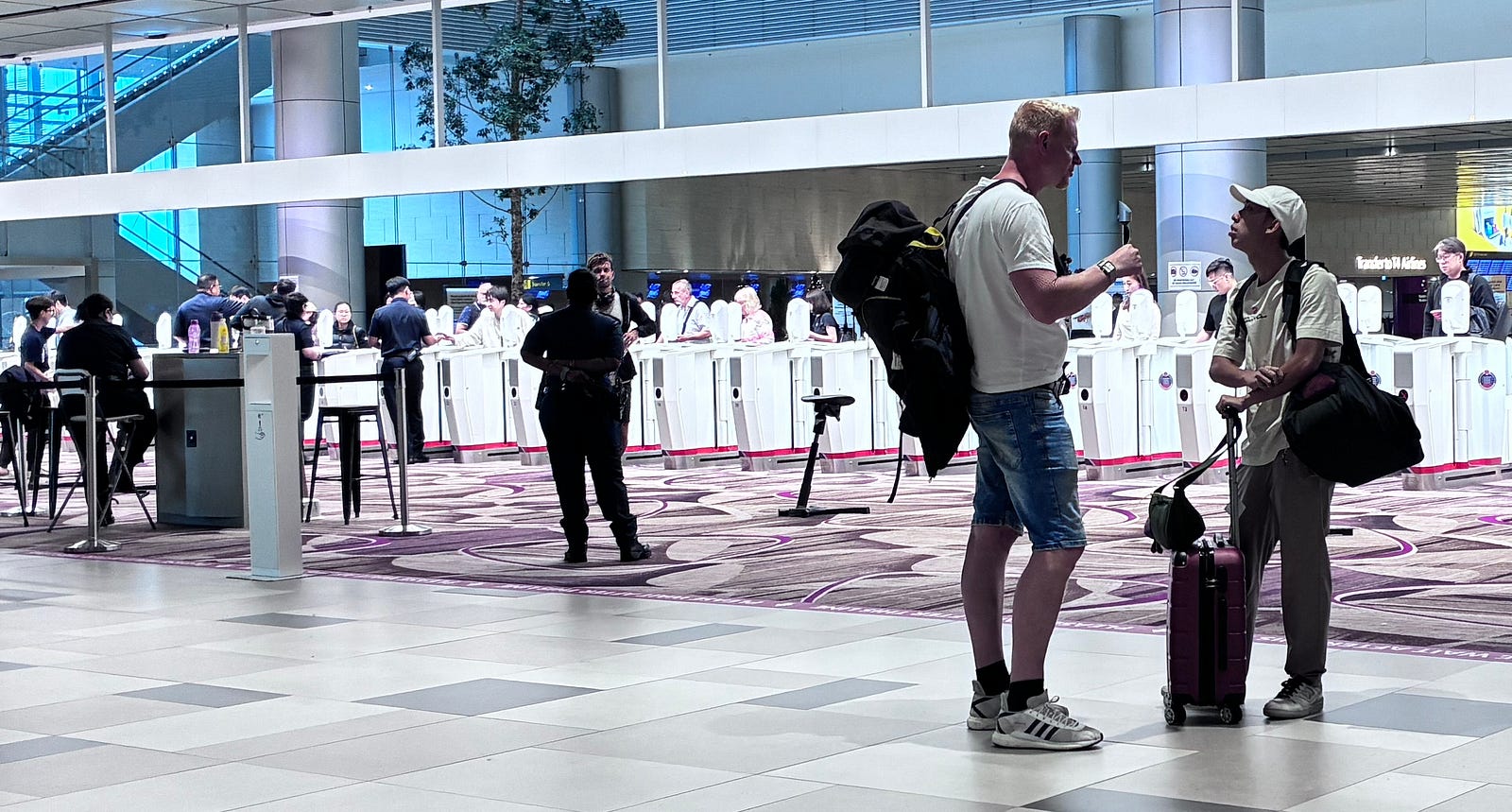
For a visitor, the first interaction with Singaporean efficiency is at Changi Airport. Passport control is entirely automated, with a vast fleet of state-of-the-art machines capturing a full set of biometrics (including fingerprints) in seconds. There are no queues. The current chaos in Europe, caused by the European Union’s Entry-Exit System (EES), could be solved instantly by deploying a small army of such machines.
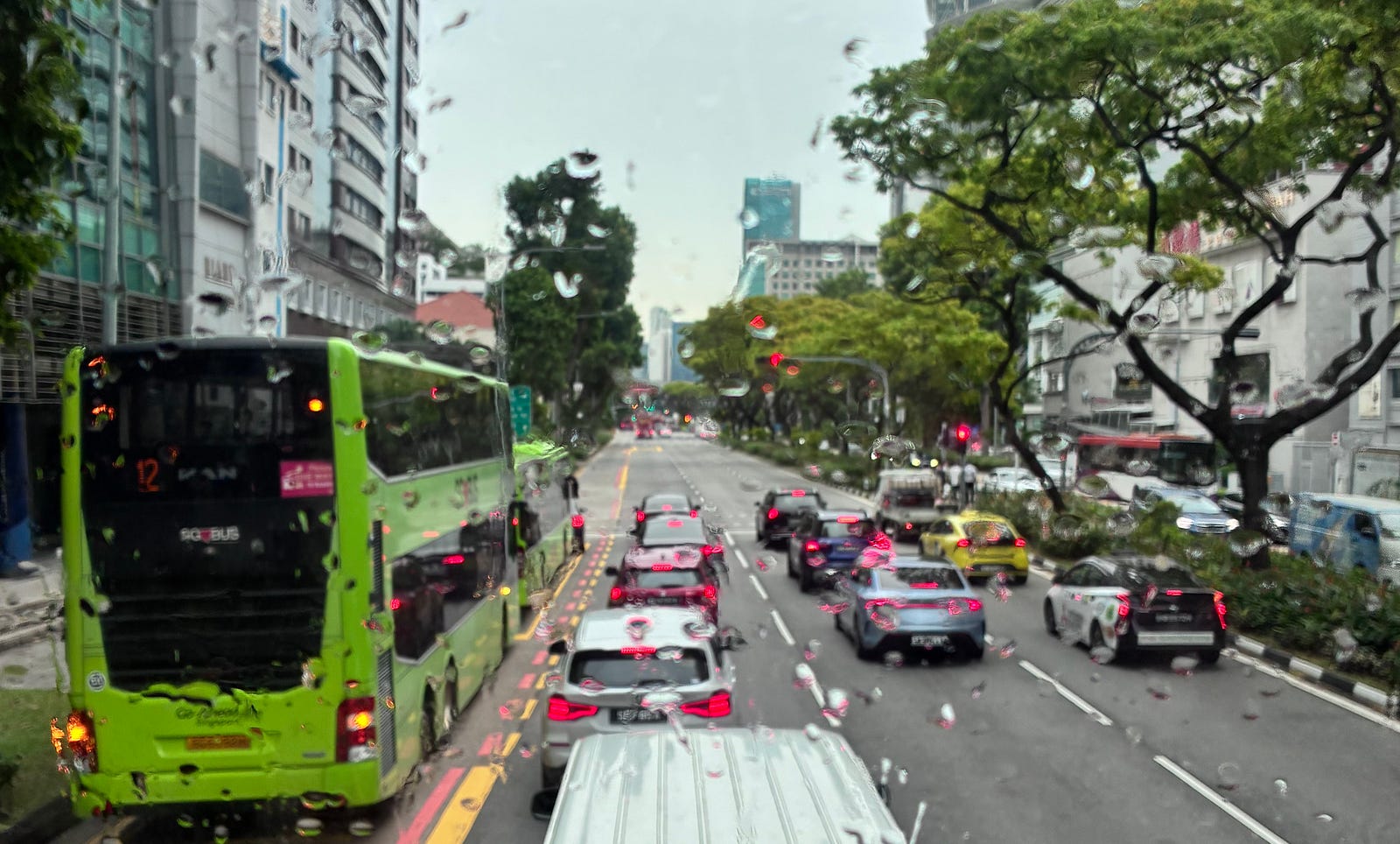
Then comes your first experience of public transport. The MRT, Singapore’s extensive, utterly efficient, and impeccably clean underground railway. It will have you in the city centre in a heartbeat. Buses meanwhile will take you to those few parts of the island not served by the MRT.
There’s no need for tickets either. Just tap in (and out—don’t forget this bit, even on buses) with any bank card and fares (charged according to how far you have travelled) will be deducted at the end of the day. A full day’s ferreting around on both the MRT and the buses will cost no more than the equivalent of about €7. It’s an efficient bargain. For those who simply can’t be doing with public transport, Grab is ubiquitous and (surprisingly, given the cost of owning a car) relatively affordable. A final day Grab from our hotel in central Little India to Changi (we by this stage had far too much to carry to be messing about with public transport) cost €15.
–
Singapore has two seasons. One is hot and wet, the other is very hot and very wet. In early December, we were broadly lucky—a couple of torrential downpours hit us (quite literally) hard but were thankfully brief. This is perfectly normal. If it does start raining during your trip to Singapore, don’t panic. It doesn’t usually last for long. It’s also worth noting that most rainfall occurs in the late afternoon. Plan your days accordingly and carry an umbrella at all times.
–
Hot off the plane and installed at our first hotel, the Holiday Inn Express Novena (affordable and recommended), we took advantage of a sunny afternoon to head for the city’s Botanical Gardens. Entrance is free, although there is a charge for the garden’s highlight, the National Orchid Garden. It does what it says on the tin: orchids sir, thousands of ‘em.
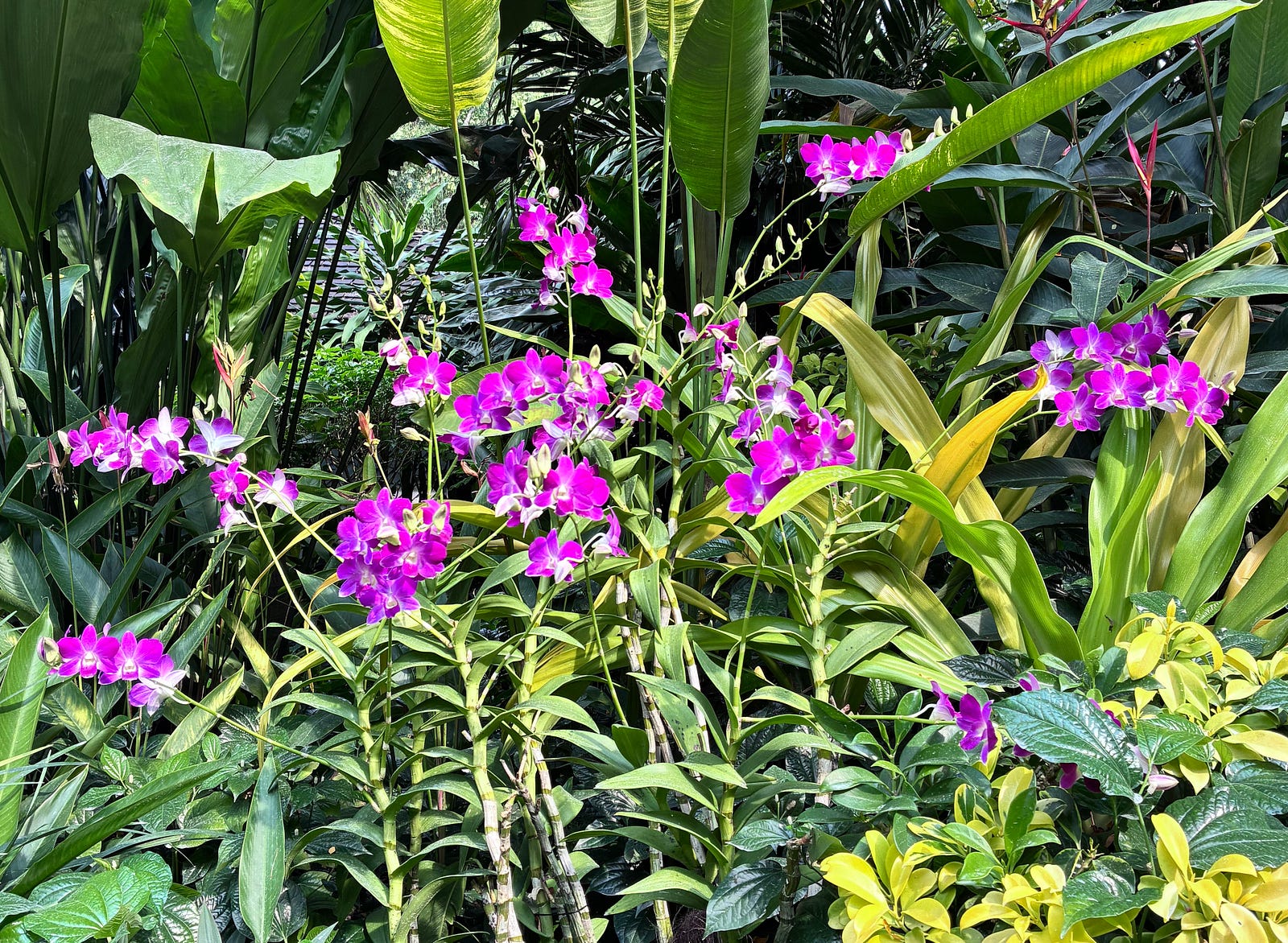
Like most paid attractions in Singapore (and, as we would discover, Malaysia), the Orchid Garden imposes dual pricing: foreigners pay three times as much as local residents. It would be the first (but not last) time on our trip when we were asked if we were pensioners. Every-so-slightly offended (we are, after all, backpacking at 50, not 60) we later realised we had missed a trick. We paid $S15 (€10) instead of the $S3 it would have cost us as over-60s. However much you pay, however, the Orchid Garden is splendid and worth every penny.
–
The Marina Bay Sands hotel may be the current poster boy of Singaporean tourism but it’s difficult to see why. It’s the kind of thing that has long been built in Dubai but would have been considered far too kitsch and tacky for Singapore until recently.
Three towers topped with a boat-shaped infinity pool? It looks like someone won a competition to design ‘the world’s most expensive hotel’ with no brief beyond making it Instagram-famous. To be fair, it worked. Everyone wants their photo up there. But that doesn’t make it good architecture.
Wander around the base and you’re hit with that peculiar artificial atmosphere of forced glamour. It’s not Singapore. It’s Las Vegas with added humidity and downpours. It all feels as though somebody decided Singapore was too understated, too subtle, and needed a bit of showbiz. A bit of ‘look-at-me’. It’s unlikely Lee Kuan Yew would have approved. The man who made modern Singapore was many things, not all of them good, but a fan of gaudy wasn’t one of them.
The Marina Bay Sands aside, the rest of the Gardens by the Bay development (built, like a quarter of Singapore, including the airport, on reclaimed land) is rather impressive, not least the giant metal trees covered in plants and the raised walkway that links the various attractions. It’s all lit up at night, the best (though busiest) time to visit. It’s enormously original (and no doubt highly technical) engineering, all in keeping with the city’s philosophy of marrying nature with the latest tech wherever possible. Nevertheless, I do feel the need to point out that Singapore does already have actual trees, magnificent ones.
Time constraints, alas, meant that we were unable to visit the Flower Dome, the world’s largest greenhouse. Next time.
–
The Indian Heritage Centre in Little India is everything the Marina Bay Sands hotel isn’t. Thoughtful, understated, genuinely interesting.
It’s a five-storey museum that traces the story of Singapore’s Indian community, from the early convict labourers and traders to today’s tech workers and restaurateurs. The exhibits are well done—artefacts, photographs—but what really makes it work are the volunteers.
The museum offers free guided tours and if you can, take one. We were lucky to arrive just as a tour was starting. Just Amelia and I and a Frenchman in his seventies who had come to Singapore to run a marathon. The guides are not museum professionals reading from scripts. They’re Indian Singaporeans, often retirees, who actually know this history because it’s their family’s history.
They’ll tell you about the spice merchants who arrived in the 1820s, the Tamil labourers who built the roads, the way Little India’s streets got their names. Why Singapore’s cows were kept in this district (Indians needed milk for their tea; the Chinese didn’t). It’s the kind of place that reminds you why you travel. Real stories, real people.
–
Singapore’s Chinatown feels a bit sterile. It’s been preserved to within an inch of its life and you are left wondering if anything is remotely authentic.
The shophouses are immaculate. The colours are perfect—pastel blues and pinks and yellows, all freshly painted. The streets are spotless. And it all feels just slightly dead.
Walk down Pagoda Street or Temple Street and you’ll find souvenir shops selling the same Singapore keychains and t-shirts you can buy anywhere. There are a few traditional businesses left—herbalists, incense shops—but bubble tea chains and tourist restaurants increasingly outnumber them.
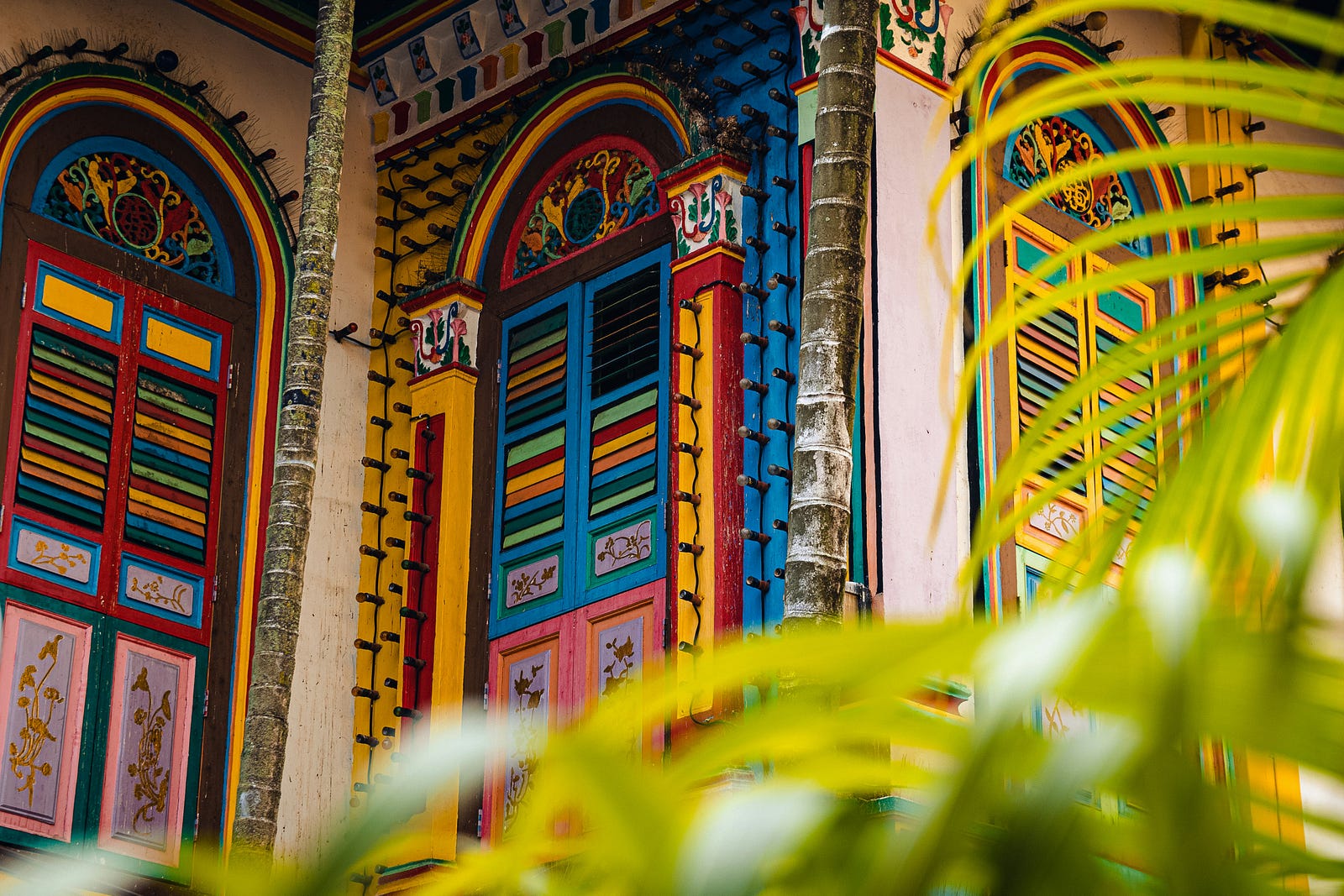
Little India, on the other hand, feels like people actually live there. The shops sell things residents need—saris, spices, religious items. The hawker centres are full of workers on their lunch breaks. The streets have that slightly chaotic energy of a neighbourhood that’s functioning, not performing.
Chinatown looks like a heritage site. Little India feels like a community. That’s the difference, and nowhere more so is this obvious than at the Tekka Centre, home to tens of tiny kitchens serving the widest variety of Indian, Pakistani (and some Chinese) food you will ever find in one place.
It’s a proper wet market on the ground floor—stalls selling fresh fish, meat, vegetables, spices in huge sacks. The floors are wet, obviously. There’s that particular smell of raw seafood and disinfectant. Vendors are shouting prices, customers are haggling, and it’s all wonderfully chaotic.
On the mezzanine level is the hawker centre. There are few tourists, just workers, families. The food is cheap, properly cheap, and excellent. Curry, biryani, and dosas the size of your arm. It’s the kind of place where you remember Singapore isn’t just a gleaming modern city-state. It’s also this—market vendors, hawker stalls, communities that have been cooking the same dishes for decades, just doing their thing. Be prepared to sit on the cheapest of plastic chairs and just enjoy your food (which you will have to pay for in cash).
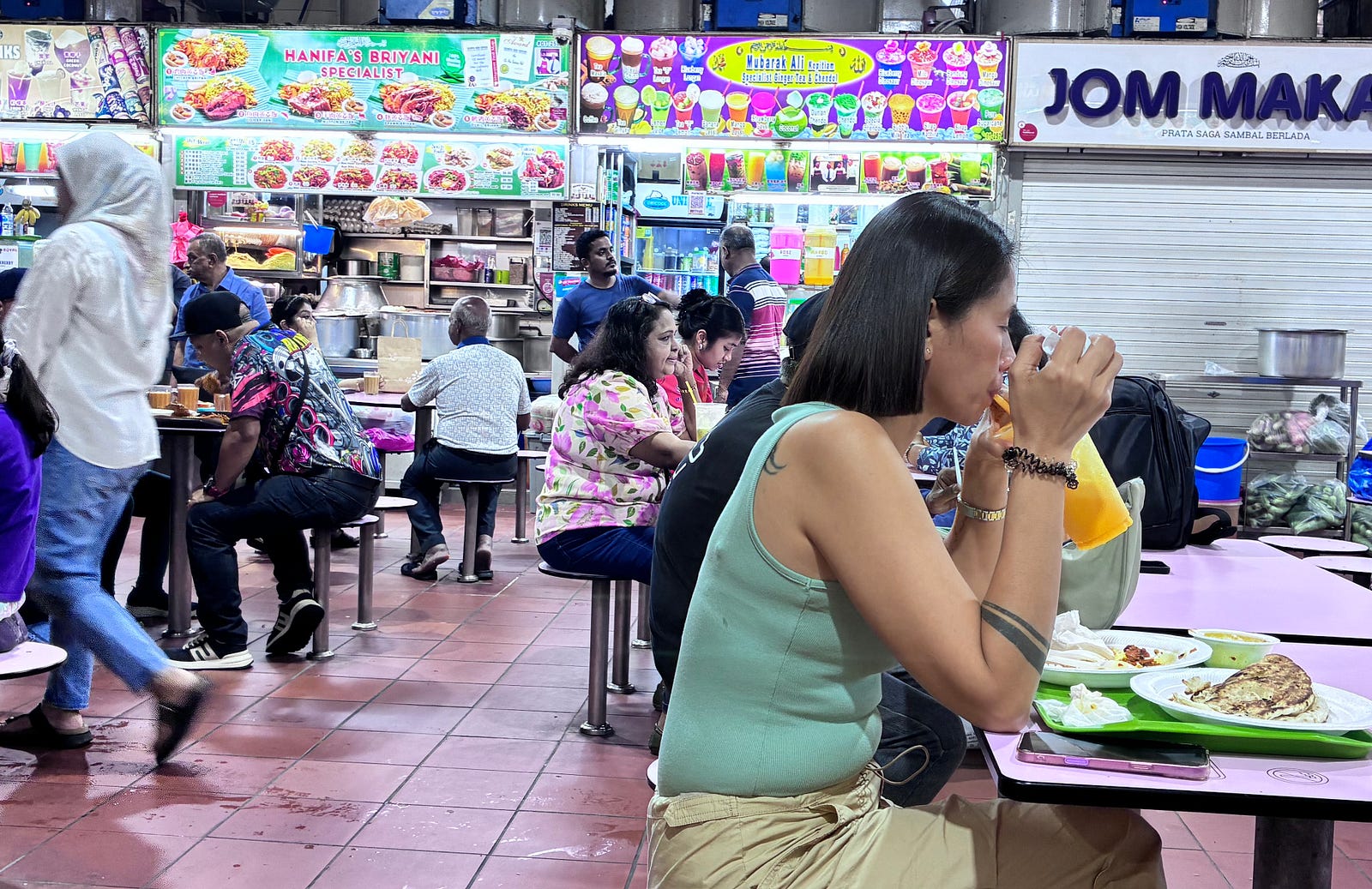
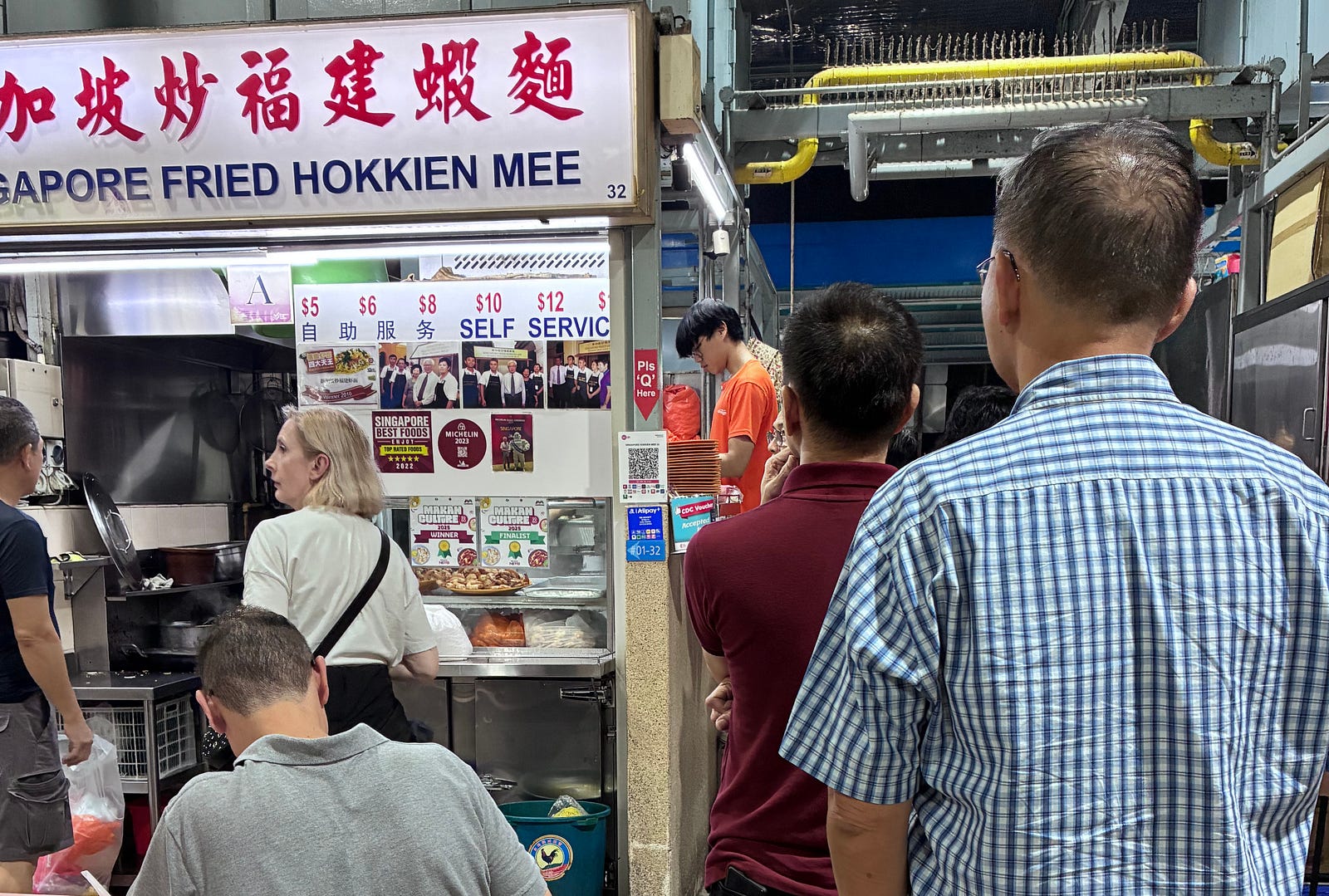
Indeed, as Tekka demonstrates, street food is not a tourist attraction in Singapore. The vast majority of the city’s apartments are tiny, with small kitchens barely worth the name. As such, most Singaporeans eat out every evening—not at restaurants but at hawker centres such as Tekka. We visited one other, Whampoa, close to our hotel. The reason for visiting (besides its proximity) was the presence of Singapore Fried Hokkien Mee, one of the island’s Michelin-listed street food joints. (Find them all here). It serves one thing: rice and egg noodles topped with prawns and squid. All you need to do is say how much you want ($S5 worth, $S6, $S8, $S12 etc.) It’s very good.
–
Arguably my favourite place in Singapore however is the madcap Mustafa Centre. A cross between a supermarket and a flea market, there’s very little you can’t find here.
It’s open 24 hours. Four floors of absolutely everything. Half-priced cracked ice and miles and miles of carpet tiles. TVs, deep freezes and David Bowie LPs. All crammed into narrow aisles with no apparent organisational logic. You’ll turn a corner from phone accessories and find yourself in confectionery, then suddenly you’re surrounded by spices and chutney, then cookware, then hair products, perfume, or fresh meat. It’s deliberately disorientating. You’re meant to wander and discover. And you will. And you’ll not leave without buying something.
The prices are low. It’s where migrant workers stock up on essentials, where locals come for bulk buying, where backpackers replace their broken phone chargers. Prepare to spend a while here.
What did I buy? Durian chocolate (of course), Bombay mix, and a kilo of insanely cheap roasted cashew nuts.
–
Notes
In all, we spent four nights in Singapore: three at the Holiday Inn Express Novena and then another, after returning from Malaysia, at Wanderlust much closer the city centre. The rooms at the latter are tiny, to say the least, but the location is fabulous.
In what is otherwise a state-of-the-art city, you will (surprisingly) need a steady supply of cash. Most street food vendors accept electronic payments, but only via QR code, not card. Signing up for one of the QR code payment services is impossible without a local debit or credit card.
We flew in the first time from Bucharest via Istanbul on Turkish Airlines, the second from Langkawi with Air Asia. Singapore’s Changi Airport (like just about everything else on the island) is both wonderful (in terms of the range of services, shops, cafes and restaurants it offers) and spectacularly efficient. Just note that when departing, security checks are conducted at the gate, not at the entrance to the departures area.
Before travelling to Singapore, all visitors need to complete an arrival card and a health declaration (here).
—
We visited (not a definitive list)
—
We ate at (again, not a definitive list)
Allauddin’s Biryani (Tekka Centre)
Heng Gi Goose and Duck Rice (Tekka Centre)